> For the complete documentation index, see [llms.txt](https://docs.eesel.ai/llms.txt). Markdown versions of documentation pages are available by appending `.md` to page URLs; this page is available as [Markdown](https://docs.eesel.ai/integrations/helpdesks/jira-service-management.md).

# Jira Service Management

Invite your AI teammate into Jira Service Management so it replies to reporters, leaves internal notes, moves and assigns issues, and creates new ones from a conversation.

Invite your AI teammate into Jira Service Management and it picks up an issue when someone raises it or comments on it. It reads the history and looks up related issues. Then it replies to the reporter, leaves an internal note, moves the issue on, assigns it, or labels it for triage.

You stay in control the whole way. Nothing runs until you create an automation. For each action you then choose: run on its own, ask you first, or stay off.

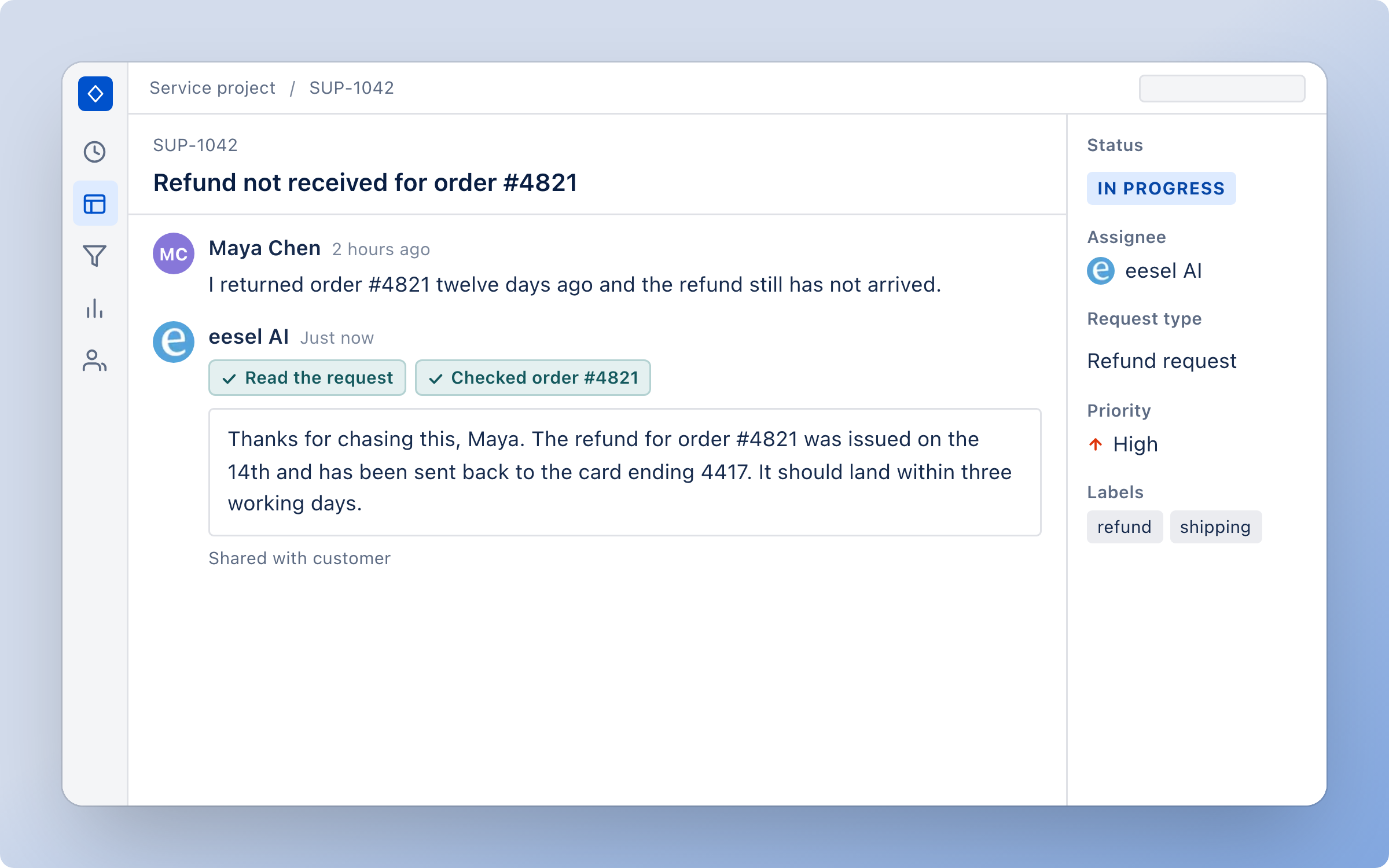
<figure><img src="https://3732419023-files.gitbook.io/~/files/v0/b/gitbook-x-prod.appspot.com/o/spaces%2F2xXO0947TYoPIhGoBgSE%2Fuploads%2Fgit-blob-9c770c84269590913750950807c9005d328d642d%2Fjira-service-management-hero.png?alt=media" alt="A Jira Service Management request about a missing refund, assigned to eesel AI, with the reply it shared with the customer after reading the request and checking the order"><figcaption><p>A Jira Service Management request where the agent answered the customer.</p></figcaption></figure>

## Quick start

{% stepper %}
{% step %}

### Ask your agent to connect Jira Service Management

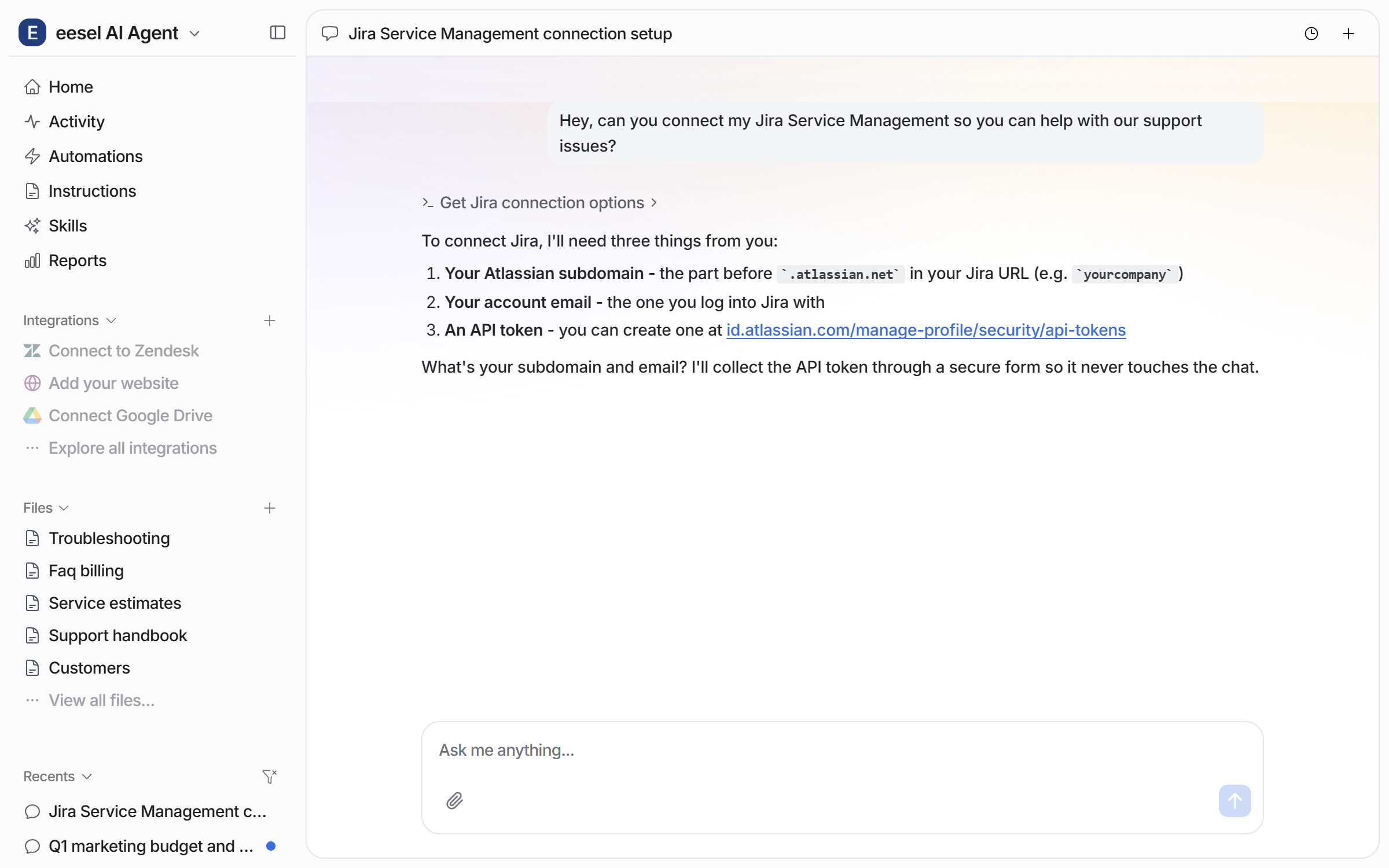
Open the chat in your dashboard and ask it to connect Jira Service Management. It asks for three things: your Atlassian subdomain, your Atlassian account email, and an application programming interface (API) token. It collects the token through a secure form, so the token never sits in the chat. Prefer to click? **Integrations** in the left sidebar has the same setup. There is one way to connect, and no Atlassian Marketplace app to install.

<figure><img src="https://3732419023-files.gitbook.io/~/files/v0/b/gitbook-x-prod.appspot.com/o/spaces%2F2xXO0947TYoPIhGoBgSE%2Fuploads%2Fgit-blob-686a8895db88213d36dcbc82bbc68f72af7044aa%2Fjira-connect-chat.png?alt=media" alt="The dashboard chat where the user asks to connect Jira Service Management, and the agent lists the subdomain, the account email and an API token as the three things it needs"><figcaption><p>The dashboard chat listing the three details it needs.</p></figcaption></figure>

Your subdomain is the part before `.atlassian.net` in your Jira address. Use `yourcompany`, not `yourcompany.atlassian.net`. Use the email on the Atlassian account you want your agent to act as, not a team alias.
{% endstep %}

{% step %}

### Create an API token in Atlassian

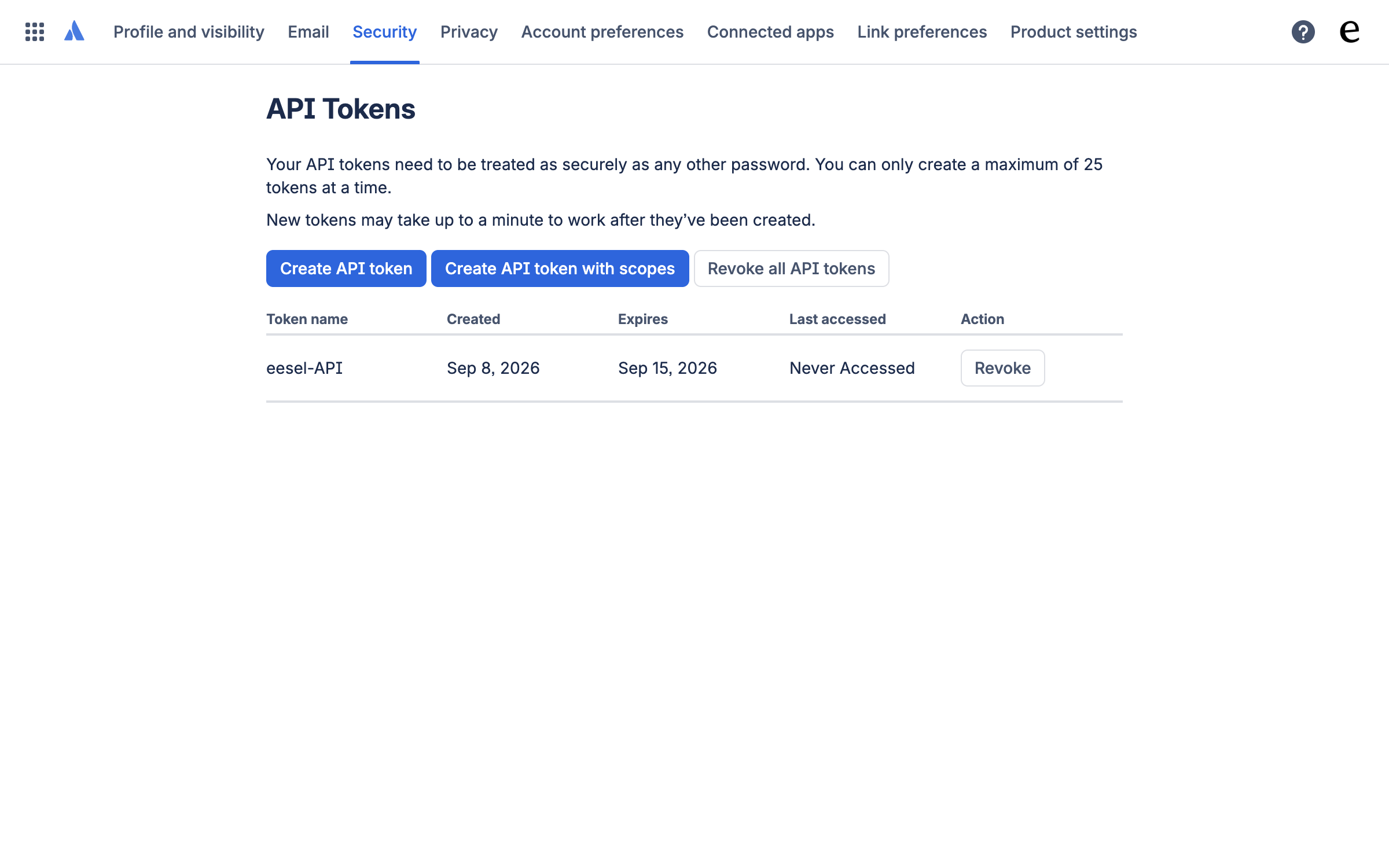
Open your Atlassian account, go to **Security**, then **API tokens**, and click **Create API token**. Name it so your team knows what it is for. Copy the token once. Atlassian does not show it again.

<figure><img src="https://3732419023-files.gitbook.io/~/files/v0/b/gitbook-x-prod.appspot.com/o/spaces%2F2xXO0947TYoPIhGoBgSE%2Fuploads%2Fgit-blob-7c589cac3dd065011a3680e0f32cb0aa2fe9450d%2Fjira-atlassian-api-tokens.png?alt=media" alt="The API tokens page in Atlassian account settings under Security, with a Create API token button and one existing token listed with its created and expiry dates"><figcaption><p>The API tokens page in your Atlassian account.</p></figcaption></figure>

A person creates this token in the browser.

Atlassian sets an expiry date on the token. When it expires, connect again with a fresh one.
{% endstep %}

{% step %}

### Paste the token into the secure form

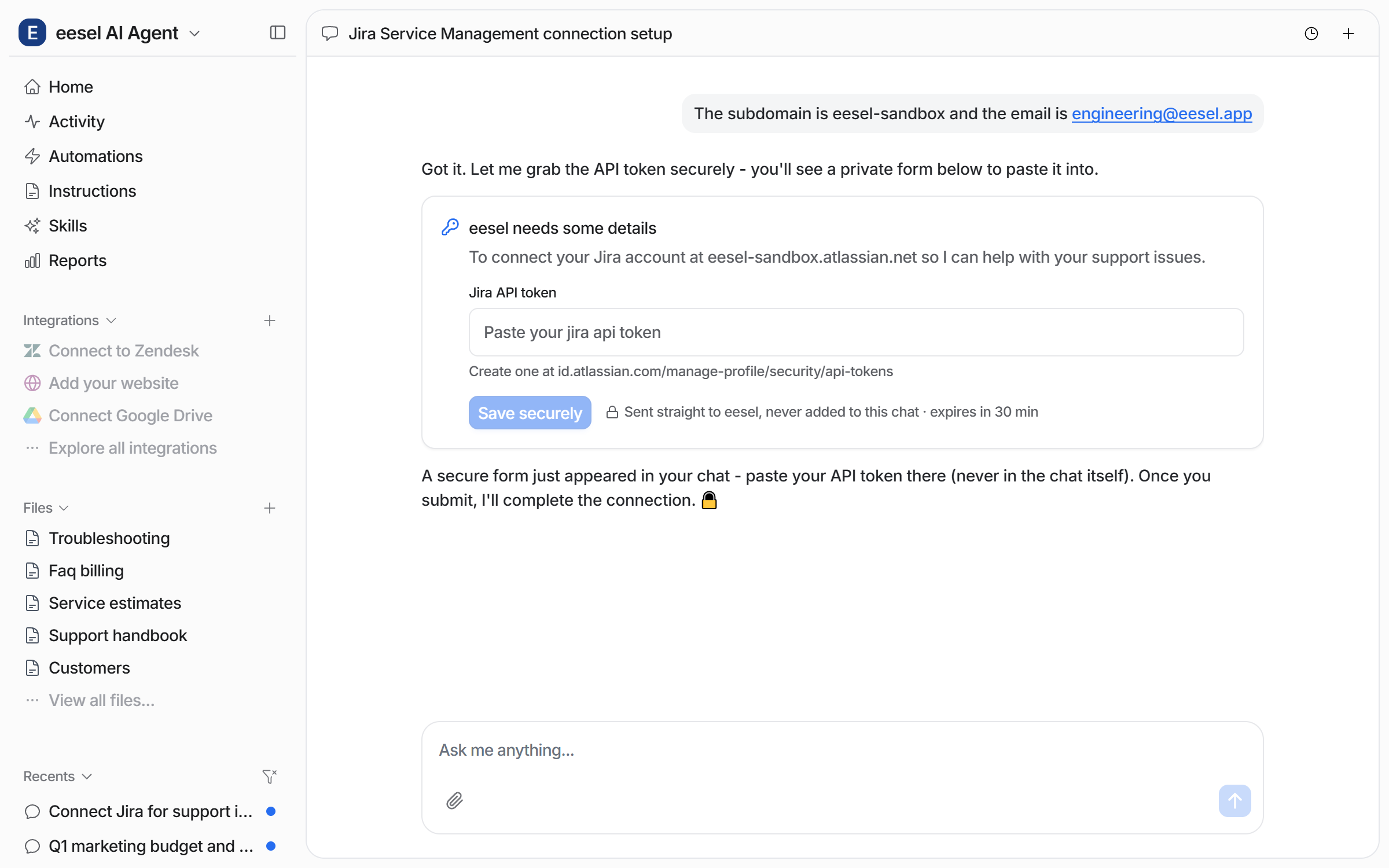
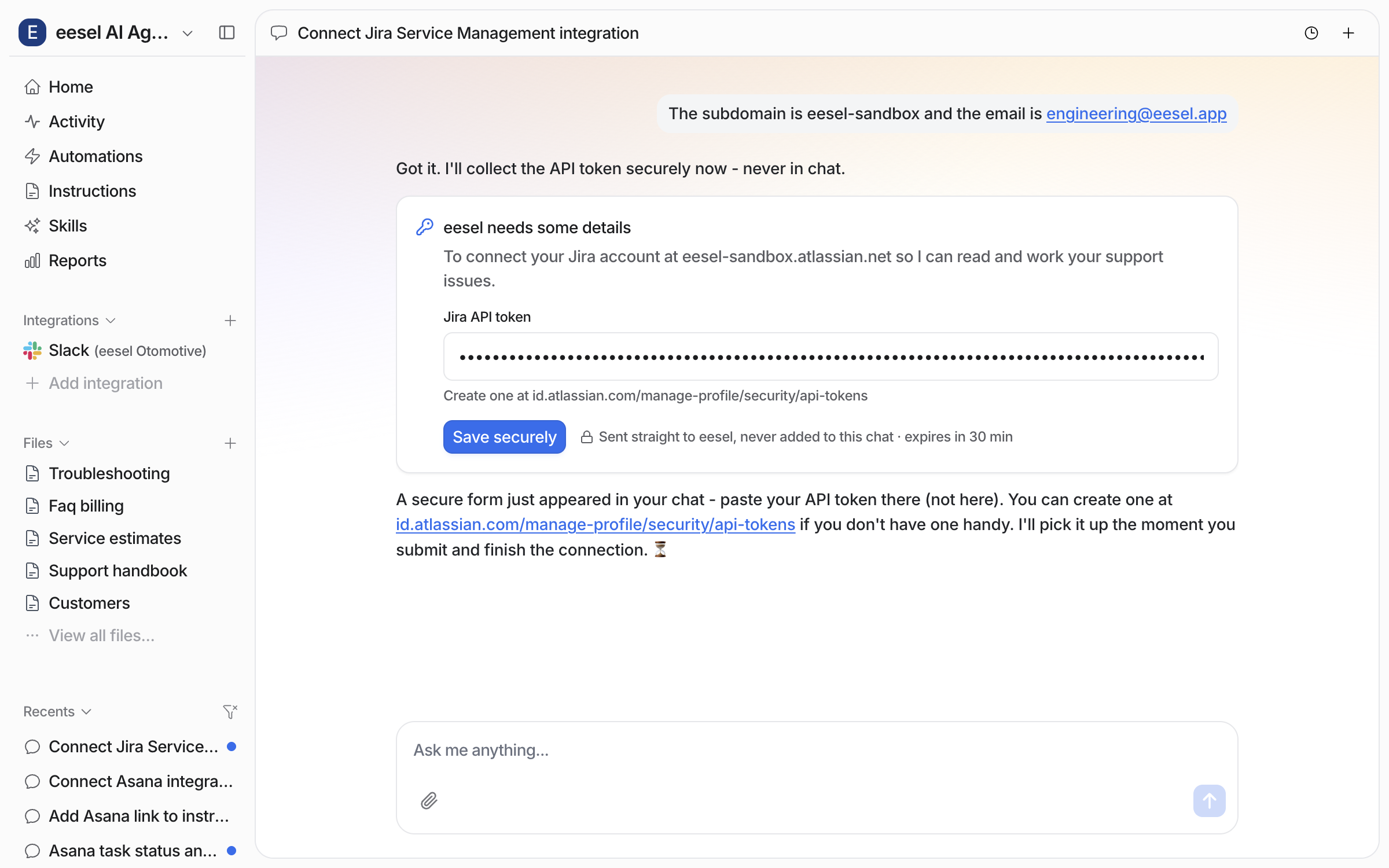
Give your agent the subdomain and the email. A secure form appears in the chat with one field for the Jira API token. Paste it there and click **Save securely**. The form sends the token straight to eesel, and it expires after 30 minutes.

<figure><img src="https://3732419023-files.gitbook.io/~/files/v0/b/gitbook-x-prod.appspot.com/o/spaces%2F2xXO0947TYoPIhGoBgSE%2Fuploads%2Fgit-blob-bedf36450f7b5cababb5340b45a30ea5f84139b9%2Fjira-secure-form.png?alt=media" alt="The dashboard chat after the user gives the subdomain and email, showing a secure form with a Jira API token field and a Save securely button"><figcaption><p>The secure form in the chat, with one field for the token.</p></figcaption></figure>

The field masks the token as you paste it.

<figure><img src="https://3732419023-files.gitbook.io/~/files/v0/b/gitbook-x-prod.appspot.com/o/spaces%2F2xXO0947TYoPIhGoBgSE%2Fuploads%2Fgit-blob-7dae83245febf7f5156e5d0d6df3c72d2147dc3f%2Fjira-secure-form-filled.png?alt=media" alt="The same secure form with the Jira API token pasted in and shown as masked dots, ready to save"><figcaption><p>The token pasted in and masked before saving.</p></figcaption></figure>
{% endstep %}

{% step %}

### Confirm the connection

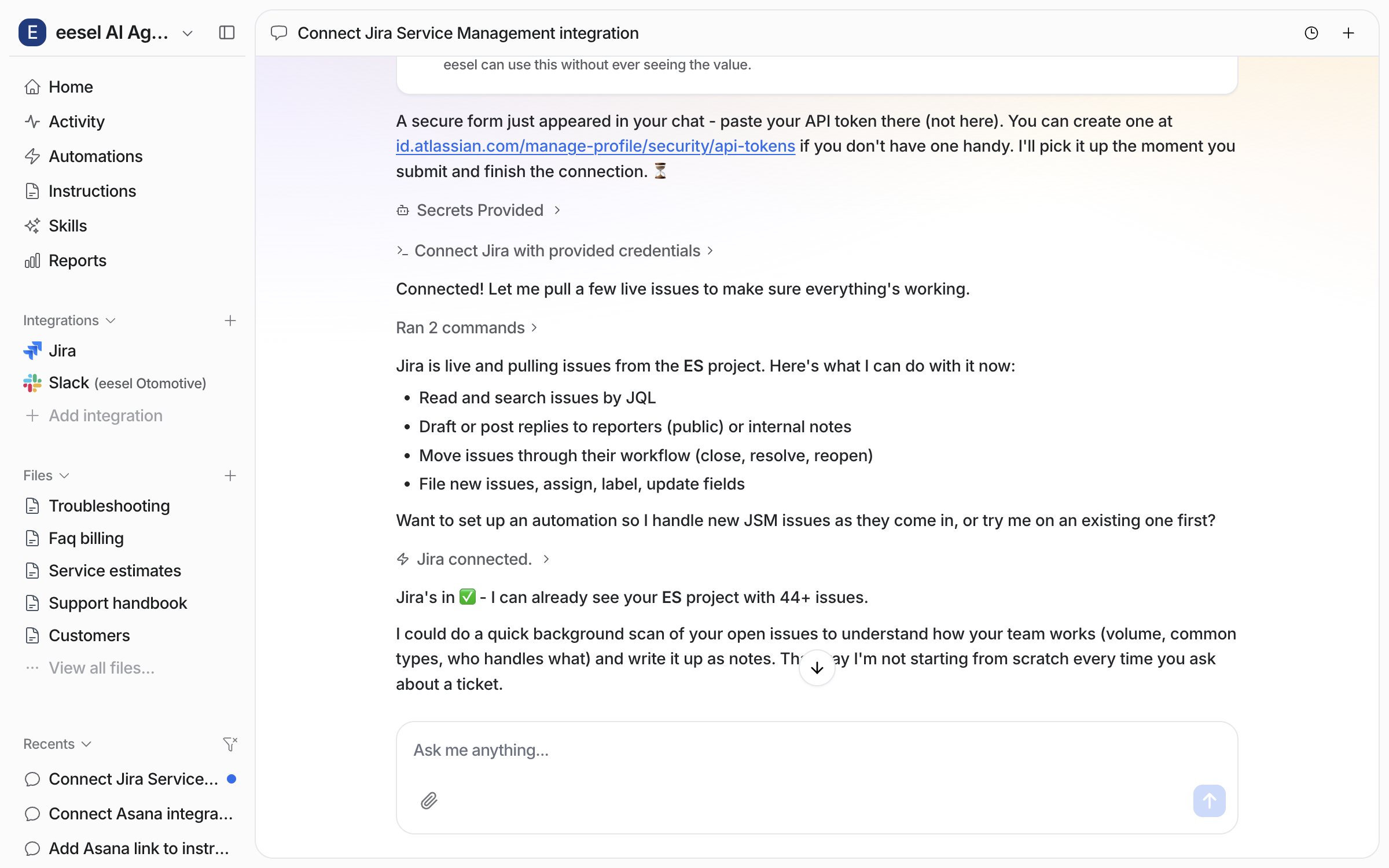
Your agent picks the token up as soon as you save it. It confirms the connection, pulls a few live issues from your project, and lists what it can now do: read and search issues, draft or post public replies and internal notes, move issues through the workflow, and file, assign, label and update them.

<figure><img src="https://3732419023-files.gitbook.io/~/files/v0/b/gitbook-x-prod.appspot.com/o/spaces%2F2xXO0947TYoPIhGoBgSE%2Fuploads%2Fgit-blob-8cb853b85dbb918c21e6397edfcdfe55651c75f4%2Fjira-connected-chat.png?alt=media" alt="The dashboard chat confirming Jira is connected, naming the project it can see and listing what it can now do with issues"><figcaption><p>The chat confirming the connection and naming the project.</p></figcaption></figure>

**Check it worked.** The left sidebar now lists Jira under Integrations. From a terminal, `eesel status` shows the integration as connected with its source counts.
{% endstep %}

{% step %}

### Check what it can read and do

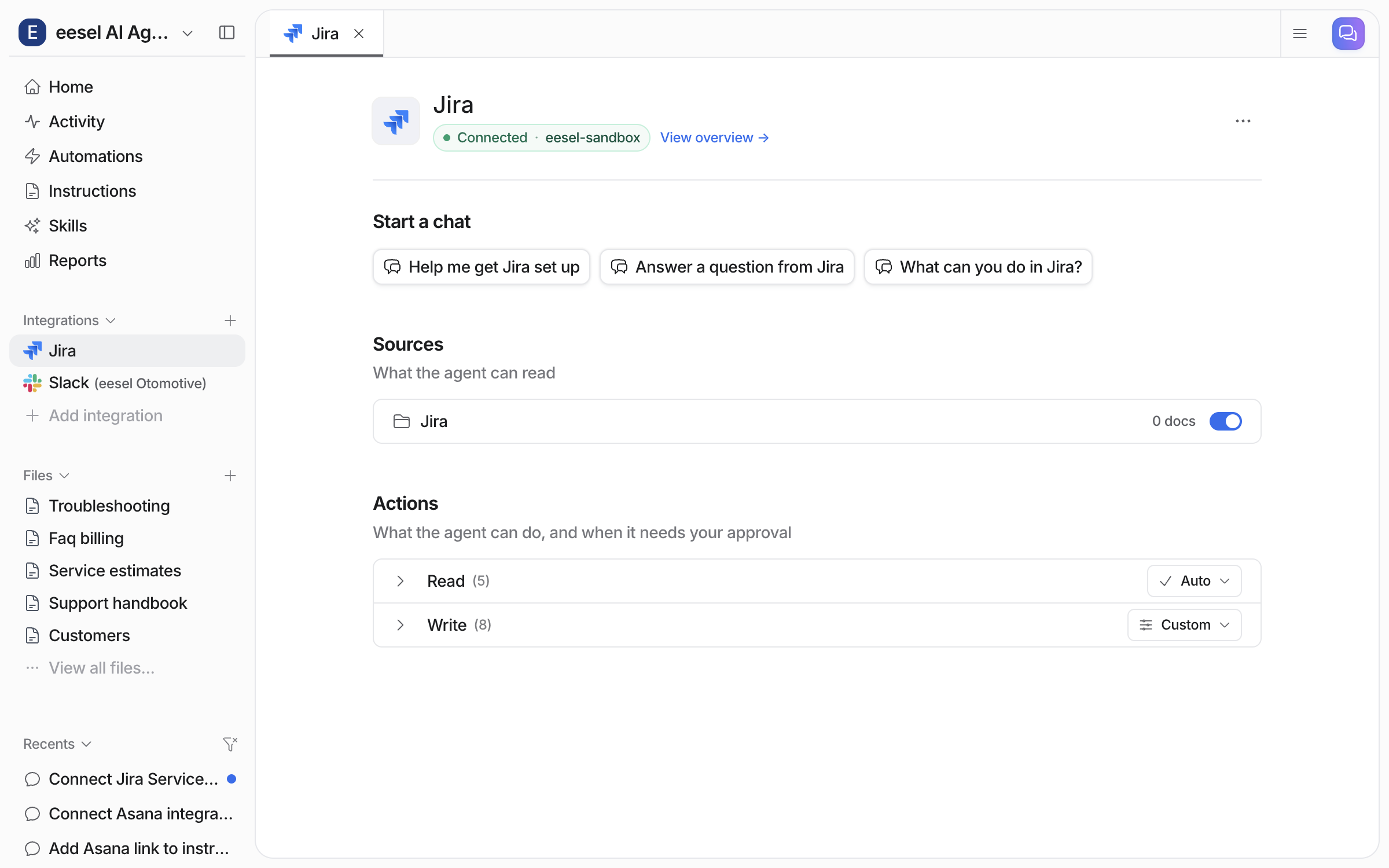
**Integrations > Jira** shows the connection as **Connected**, with your Atlassian site name. **Sources** lists one Jira source with its document count and toggle. **Actions** splits into **Read**, which runs on its own, and **Write**, set to Custom so you choose each write action.

<figure><img src="https://3732419023-files.gitbook.io/~/files/v0/b/gitbook-x-prod.appspot.com/o/spaces%2F2xXO0947TYoPIhGoBgSE%2Fuploads%2Fgit-blob-77d6fb9e74cea42b930a9d2924f3c6a427cd2c59%2Fjira-integration-page.png?alt=media" alt="The Jira integration page in eesel showing Connected with the Atlassian site name, a Jira source row with its document count and toggle, and the Read and Write action groups"><figcaption><p>The Jira integration page, with the source row and the two action groups.</p></figcaption></figure>

The document count stays at zero. Jira Service Management copies no issues into your agent's knowledge. The look-up actions are its source, so it reads what is on the board right now.
{% endstep %}

{% step %}

### Create your first automation

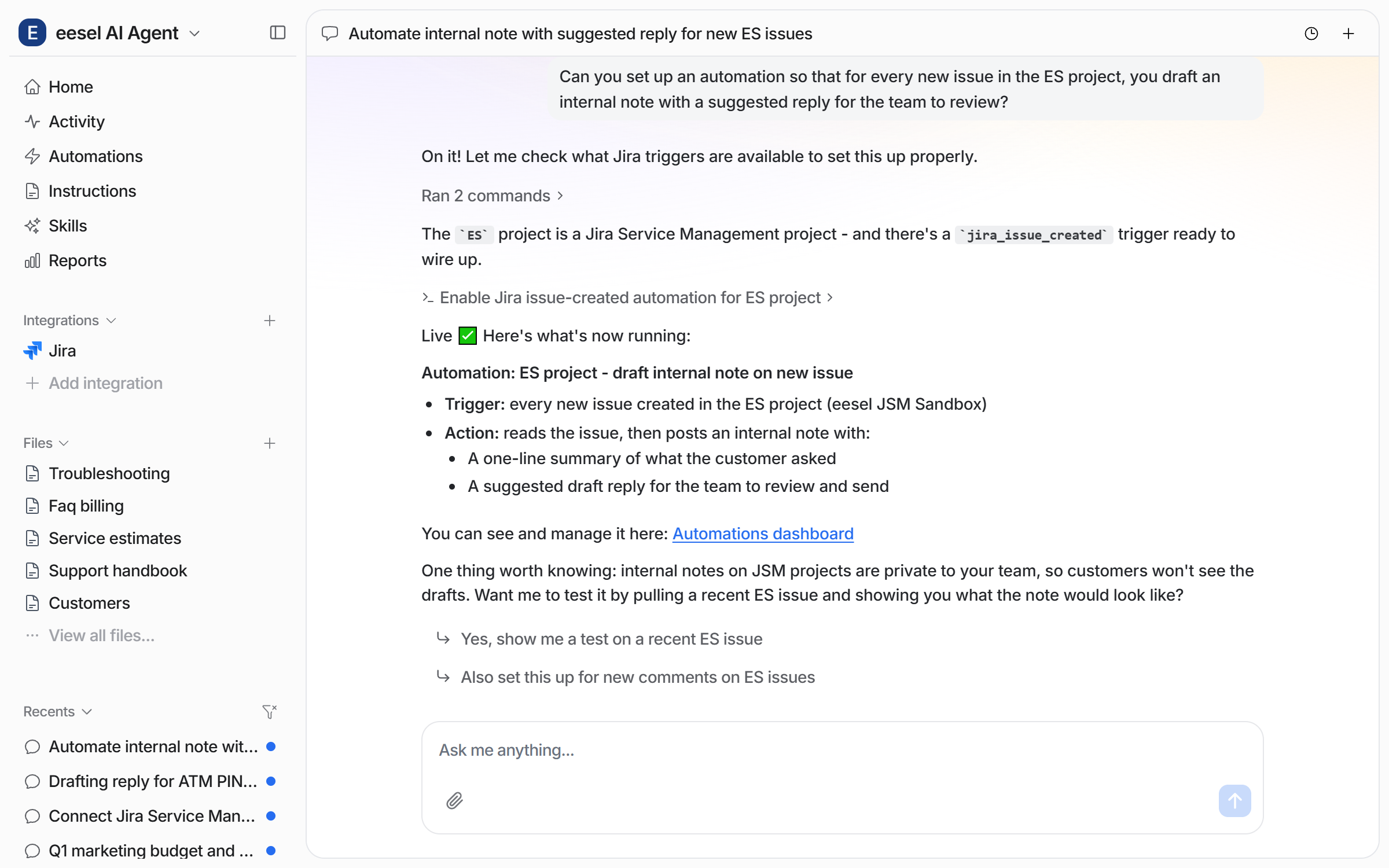
Connecting alone does not start your agent. It needs an automation first. Tell it what to handle and it creates an [automation](/automations-and-schedules/automations-and-schedules.md). An automation is a Jira trigger plus instructions. In the instructions you describe which issues it should handle and what to do with them. It leaves the rest alone.

<figure><img src="https://3732419023-files.gitbook.io/~/files/v0/b/gitbook-x-prod.appspot.com/o/spaces%2F2xXO0947TYoPIhGoBgSE%2Fuploads%2Fgit-blob-acd0c54a12e2df078657772956ba7bf2bf3e35d5%2Fjira-automation-chat.png?alt=media" alt="The dashboard chat where the user asks for an automation that drafts an internal note on every new issue in a project, and the agent reports the trigger and action it created"><figcaption><p>The dashboard chat where the agent builds the automation.</p></figcaption></figure>

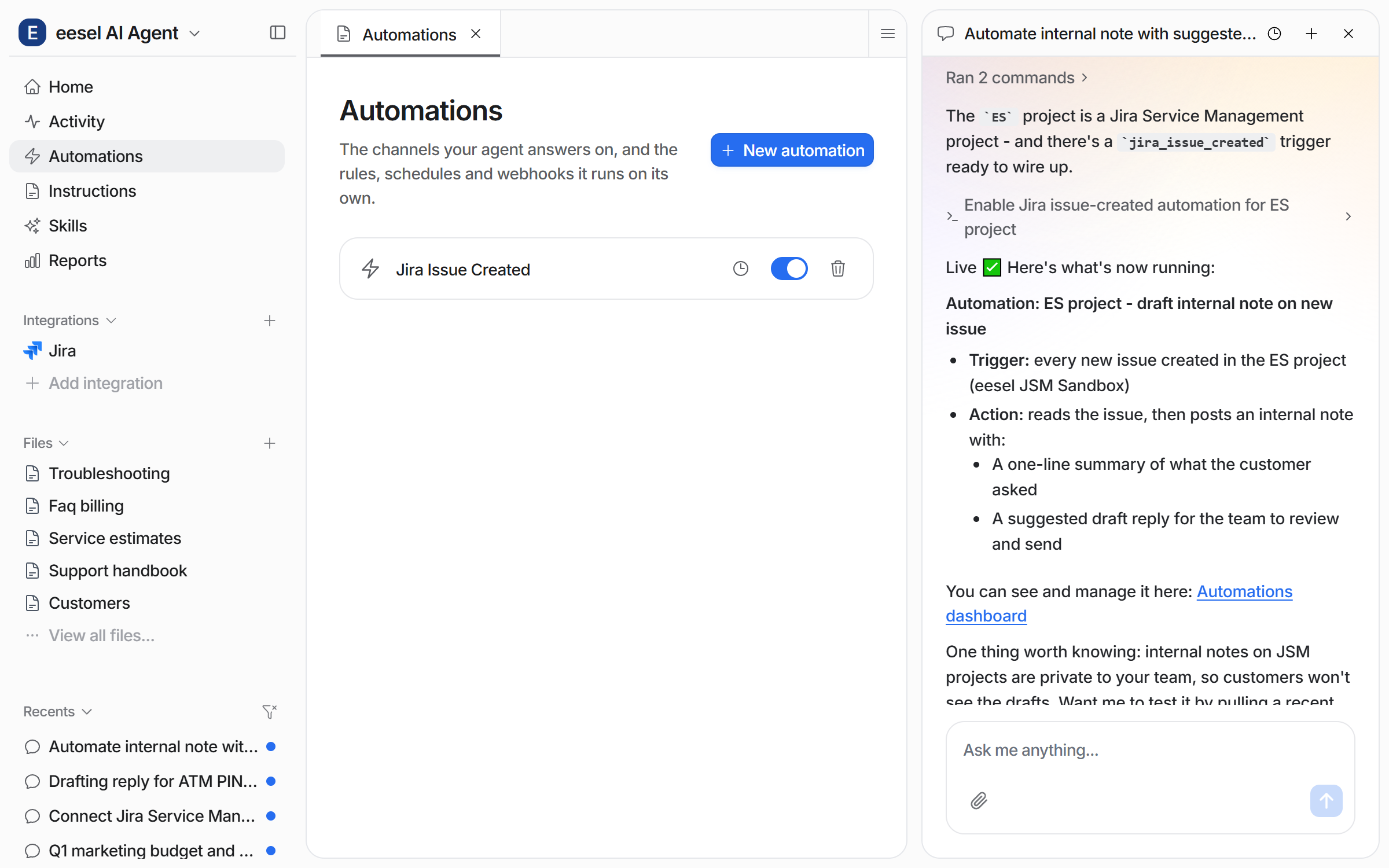
The automation shows up on your **Automations** page, switched on. The chat beside it names the trigger event and the action.

<figure><img src="https://3732419023-files.gitbook.io/~/files/v0/b/gitbook-x-prod.appspot.com/o/spaces%2F2xXO0947TYoPIhGoBgSE%2Fuploads%2Fgit-blob-9fabdc9934ed6117717b3824bce9aff43ad57dea%2Fjira-automation-live.png?alt=media" alt="The Automations page in eesel with the Jira Issue Created automation switched on, and the chat open beside it reporting the trigger and the action"><figcaption><p>The new automation on your Automations page, switched on.</p></figcaption></figure>

The trigger event is fixed when the automation is created. So a new automation is required for each different trigger event.

**Check it worked.** Your **Automations** page lists the automation, switched on. From a terminal, `eesel automations` lists the automation as on.
{% endstep %}

{% step %}

### Tell it how to write its notes

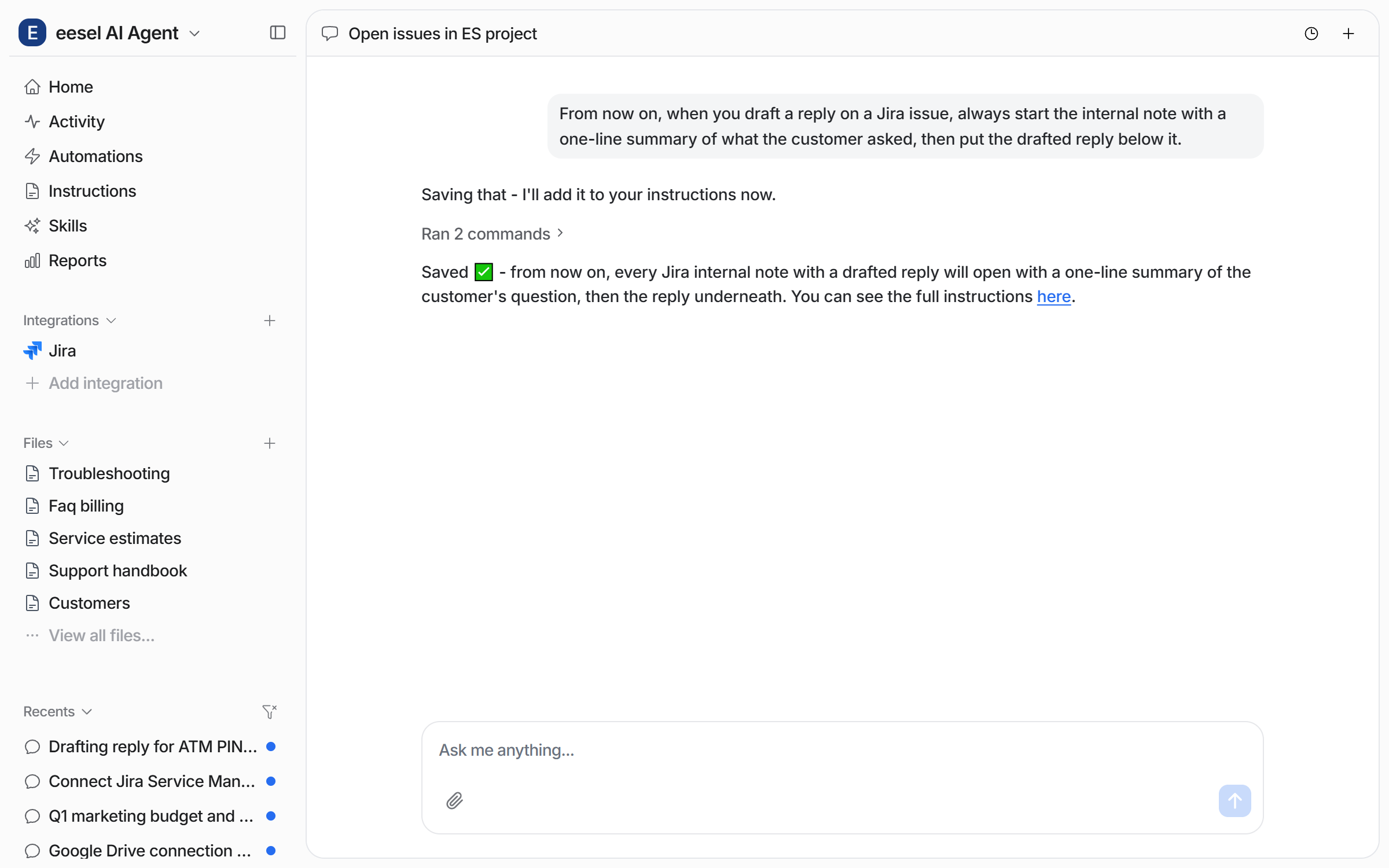
Tell your agent how you want its internal notes laid out, and it saves the rule to your instructions. It applies from the next issue onwards.

<figure><img src="https://3732419023-files.gitbook.io/~/files/v0/b/gitbook-x-prod.appspot.com/o/spaces%2F2xXO0947TYoPIhGoBgSE%2Fuploads%2Fgit-blob-475c688b0a995b8cac8a9cec13c0f721cde73640%2Fjira-instruction-chat.png?alt=media" alt="The dashboard chat where the user gives a standing rule for how internal notes on Jira issues should be laid out, and the agent confirms it saved the rule to the instructions"><figcaption><p>A standing rule given in chat and saved.</p></figcaption></figure>

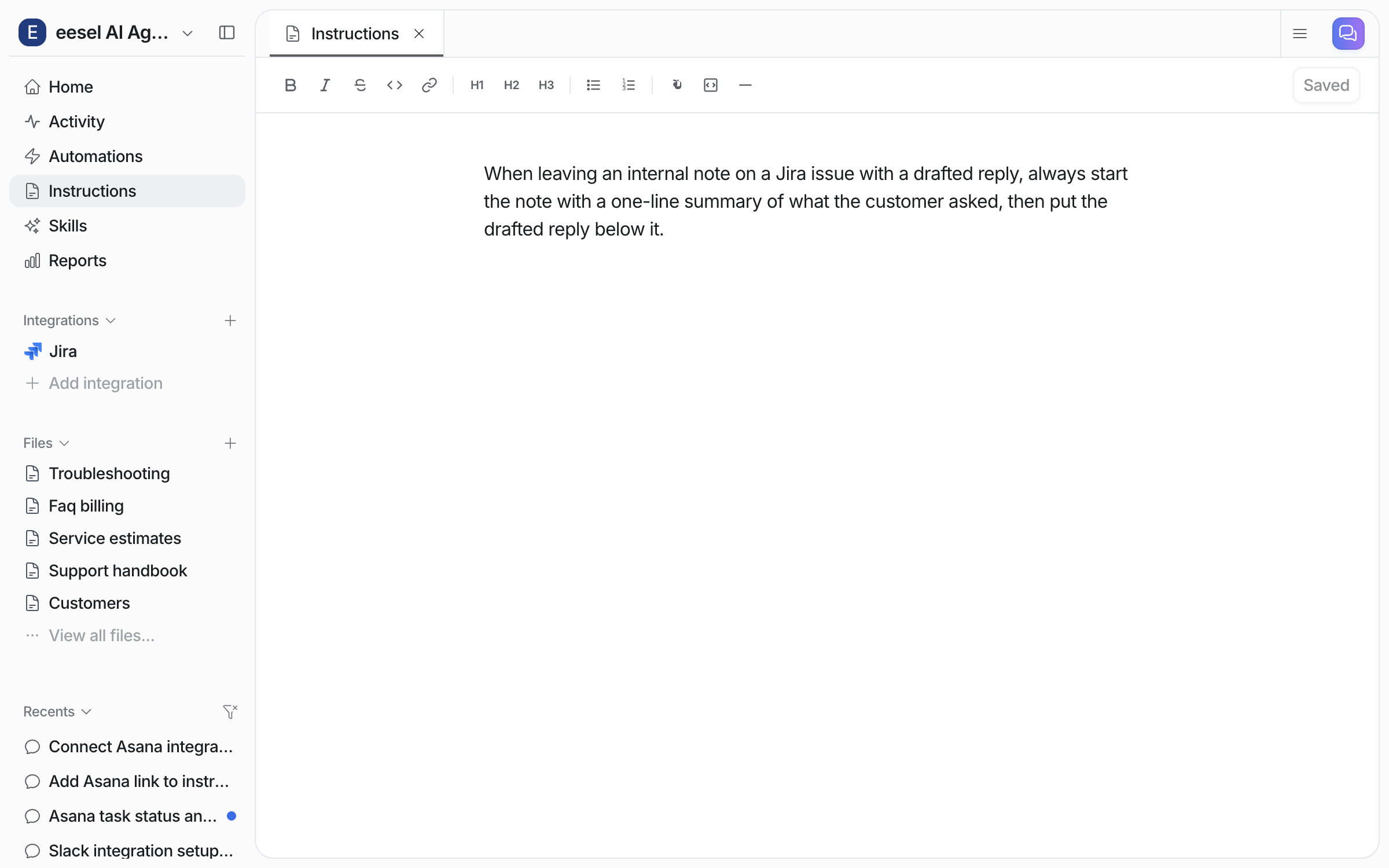
The rule is now on your **Instructions** page, where you can read or edit it yourself.

<figure><img src="https://3732419023-files.gitbook.io/~/files/v0/b/gitbook-x-prod.appspot.com/o/spaces%2F2xXO0947TYoPIhGoBgSE%2Fuploads%2Fgit-blob-cb9ca360010205878d2d7d1b8484fd7f5199a4f7%2Fjira-instruction-saved.png?alt=media" alt="The Instructions page in eesel showing the saved rule about how to lay out an internal note on a Jira issue"><figcaption><p>The saved rule on the Instructions page.</p></figcaption></figure>
{% endstep %}

{% step %}

### Check automation work in Jira Service Management

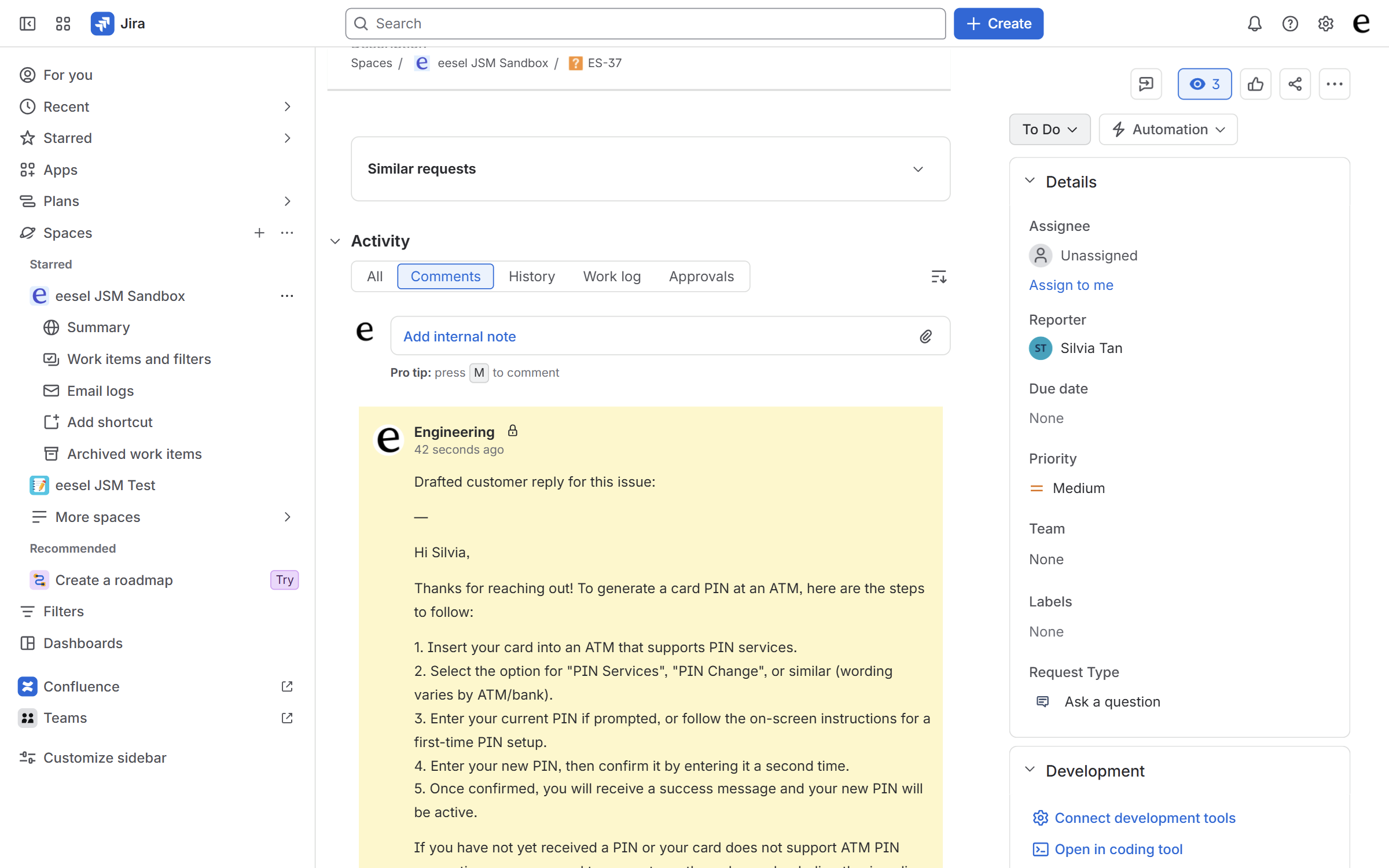
Open Jira Service Management and look at the next issue that comes in. The internal note is on the issue, in the layout you asked for, waiting for a teammate to review and send.

<figure><img src="https://3732419023-files.gitbook.io/~/files/v0/b/gitbook-x-prod.appspot.com/o/spaces%2F2xXO0947TYoPIhGoBgSE%2Fuploads%2Fgit-blob-8e0cd1abe4e942a63e9e54de28ae0be16c1e3adb%2Fjira-note-on-issue.png?alt=media" alt="A Jira Service Management issue with an internal note from the agent holding a drafted customer reply, alongside the issue details panel"><figcaption><p>The drafted reply waiting as an internal note on the issue.</p></figcaption></figure>
{% endstep %}
{% endstepper %}

{% hint style="info" %}
**From Claude Code, Cursor or a terminal.** The same setup works as commands: `eesel login`, then `eesel integrations connect jira`, which prints the details that connection method needs. `eesel status` then shows the integration as connected with its source counts, and `eesel automations` lists your automations. Pasting the API token and switching an automation on have no command, so use the dashboard chat for those. Creating the token is a human step: print the Atlassian link for a person, wait for the connection status to change, and do not retry the link. Full command reference: [The eesel CLI](/apis-and-developer-resources/cli.md). Step-by-step: [Set up from Claude Code or the terminal](/getting-started/set-up-from-a-coding-agent.md). From an MCP client: [Claude Code and MCP clients](/apis-and-developer-resources/claude-code-and-mcp-clients.md).
{% endhint %}

## Sources, triggers and actions

### Sources

Jira Service Management is a place your agent works, not a knowledge source it copies in.

| Source   | Description                                                                | Document count                            |
| -------- | -------------------------------------------------------------------------- | ----------------------------------------- |
| **Jira** | Live issue data, read through the look-up actions when your agent needs it | Always zero, because nothing is copied in |

With **Get Issue** and **Search Issues** on, your agent pulls issue data with Jira Query Language (JQL) as it works. So answers come from what is on the board right now.

For product and policy knowledge, every other integration on your agent works alongside Jira. If your team documents in [Confluence](/integrations/knowledge/confluence.md), that is the natural pairing. See [Integrations](/integrations/overview.md).

### Triggers

Triggers are the Jira Service Management events an automation can run on.

| Trigger                  | Fires when                         | Best for                    | Key                    |
| ------------------------ | ---------------------------------- | --------------------------- | ---------------------- |
| **Jira Issue Created**   | Someone raises a new issue         | First response and triage   | `jira_issue_created`   |
| **Jira Issue Commented** | Someone adds a comment to an issue | Following a request through | `jira_issue_commented` |

Nothing else fires. There is no @eesel mention trigger, and a status or field change does not start a run.

In the automation's instructions, describe the issues you want in plain language, for example only issues in one project raised by external customers, and what to do with them. Your agent checks each event against that before acting. Skipped issues are recorded on the automation's activity, with the reason.

{% hint style="info" %}
**eesel sets up the Jira Automation rule for you.** Jira does not push issue events to eesel on its own. When you turn on a Jira trigger, eesel creates a "Send web request" rule in your Jira instance's Automation settings. It removes the rule when you turn the trigger off. The account behind your API token does need rights to administer Jira automation. Without them, connecting works but turning on a trigger fails.
{% endhint %}

### Actions

Actions are what it can do. Every action runs on its own, asks you first, or stays off.

|             | Action              | What it does                                                                                 |
| ----------- | ------------------- | -------------------------------------------------------------------------------------------- |
| **Respond** | Reply to Issue      | Posts a public comment, visible to the reporter                                              |
|             | Leave Note on Issue | Posts an internal-only comment. Most teams start here, so the agent drafts and a human sends |
| **Manage**  | Create Issue        | Files a new issue, with project, summary, description, assignee and labels                   |
|             | Assign Issue        | Assigns an issue to a person                                                                 |
|             | Label Issue         | Adds labels to an issue                                                                      |
|             | Transition Issue    | Moves an issue through its workflow, so close, resolve, reopen or start progress             |
|             | Update Issue        | Edits an issue's summary, description, priority, due date or custom fields                   |
| **Look up** | Get Issue           | Reads one issue by its key, with status, description, assignee, priority and labels          |
|             | Search Issues       | Finds issues with a JQL query, so your agent can find related or duplicate issues            |
|             | List Projects       | Lists the projects the connected account can see, with each key, name and type               |
|             | List Transitions    | Lists the workflow moves an issue currently allows, checked before moving it                 |
|             | Look Up User        | Finds a person's Jira account identifier from their display name or email                    |

Ask your agent to assign an issue by name and it runs **Look Up User** first, then assigns. So plain names in your instructions are fine.

Updating an issue replaces its description in full, and status and assignee are separate actions. Setting the reporter on a new issue needs the connected Jira account to hold the project's Modify Reporter permission.

Replying and leaving a note are two separate actions, not one comment action with a visibility switch. Keep **Reply to Issue** off, or on approval, while your agent earns trust. See [Actions and Approvals](/instructions-and-memory/actions-and-approvals.md).

The connection asks Jira for permission to read issues, create issues, update issues, read projects and read users.

## Troubleshooting

<details>

<summary>Connection failing, or the setup form keeps reappearing?</summary>

Enter the subdomain on its own, so `yourcompany` and not `yourcompany.atlassian.net`. Use the email on the Atlassian account rather than a team alias. Paste a fresh API token whole from your [Atlassian account security settings](https://id.atlassian.com/manage-profile/security/api-tokens). A new token can take up to a minute to work. The secure form expires after 30 minutes, so ask your agent for a new one if it has been sitting there.

</details>

<details>

<summary>Turning on a trigger fails?</summary>

eesel has to create an Automation rule in your Jira instance to receive issue events. The account behind your API token needs rights to administer Jira automation. Connect again with an account that has them, then turn the trigger on.

</details>

<details>

<summary>Agent not picking up issues?</summary>

Check the automation is on your **Automations** page and switched on, that its instructions cover the issues you expect, and that at least one action is on. Then check eesel's rule still exists and is enabled in Jira's Automation settings. If someone deleted or disabled it, eesel stops receiving events. Turn the trigger off and on again to recreate the rule.

</details>

<details>

<summary>Agent replies but the reporter cannot see it?</summary>

That is **Leave Note on Issue**, which is internal only. Turn on **Reply to Issue** for comments the reporter sees.

</details>

<details>

<summary>Assigning by name fails?</summary>

Your agent resolves a name with **Look Up User** before it assigns, so check that action is on. If two people share a display name, give the email address instead.

</details>

## FAQ

<details>

<summary>Does connecting Jira start acting on issues automatically?</summary>

No. Connecting only gives your agent access. It does nothing until you turn on a trigger and at least one action.

</details>

<details>

<summary>How do I keep a human in the loop?</summary>

Two ways, and you can use both. Turn on **Leave Note on Issue** instead of **Reply to Issue**, so your agent writes its answer as an internal comment your team reads, edits and sends. Or set individual actions to ask you first, so your agent shows you what it wants to do and waits. In the dashboard the approval offers Approve, Always allow and Deny.

</details>

<details>

<summary>Can I train the agent on my past Jira issues?</summary>

No. Jira Service Management copies no content into your agent's knowledge. It is there so your agent can act on issues and be triggered by them. Knowledge comes from other sources, such as Confluence, your help center, your website, or uploaded files. Your agent uses all of them while working a Jira issue.

</details>

<details>

<summary>Is the Jira Service Management Messenger widget supported?</summary>

No. JSM Messenger is not supported. If you want a chat widget on your own site, use the eesel chat bubble instead. See [Website](/integrations/knowledge/website.md).

</details>

<details>

<summary>How is this billed?</summary>

Pay-as-you-go. An issue your agent handles is one task, however many comments happen on it. Chats you run yourself from the eesel dashboard are free. See [Pricing](/pricing/overview.md) for rates, the annual commitment, and Enterprise.

</details>

<details>

<summary>How do I disconnect?</summary>

Disconnect Jira from its page under **Integrations** in the left sidebar. That removes the triggers tied to the connection, so your agent stops running. On Jira's side, check eesel's rule is gone from your Automation settings, then revoke the API token in your Atlassian account.

</details>

## Related pages

* [Helpdesk](/use-cases/helpdesk.md) for the job your agent takes on from day one
* [Confluence](/integrations/knowledge/confluence.md) for the knowledge it answers from while working an issue
* [Actions and Approvals](/instructions-and-memory/actions-and-approvals.md) for setting each action to run on its own, ask you first, or stay off
* [Integrations overview](/integrations/overview.md) for how sources, triggers and actions fit together
* [Set up from Claude Code or the terminal](/getting-started/set-up-from-a-coding-agent.md)


---

# Agent Instructions
This documentation is published with GitBook. GitBook is the documentation platform designed so that both humans and AI agents can read, navigate, and reason over technical content effectively. Learn more at gitbook.com.

## Querying This Documentation
If you need additional information that is not directly available in this page, you can query the documentation dynamically by asking a question.

Perform an HTTP GET request on the current page URL with the `ask` query parameter, and the optional `goal` query parameter:

```
GET https://docs.eesel.ai/integrations/helpdesks/jira-service-management.md?ask=<question>&goal=<endgoal>
```

`ask` is the immediate question: it should be specific, self-contained, and written in natural language.
`goal` is optional and describes the broader end goal you are ultimately trying to accomplish on behalf of the user. GitBook uses it to tailor the answer towards what is most useful for that goal.

The response will contain a direct answer to the question and relevant excerpts and sources from the documentation.

Use this mechanism when the answer is not explicitly present in the current page, you need clarification or additional context, or you want to retrieve related documentation sections.