Notion
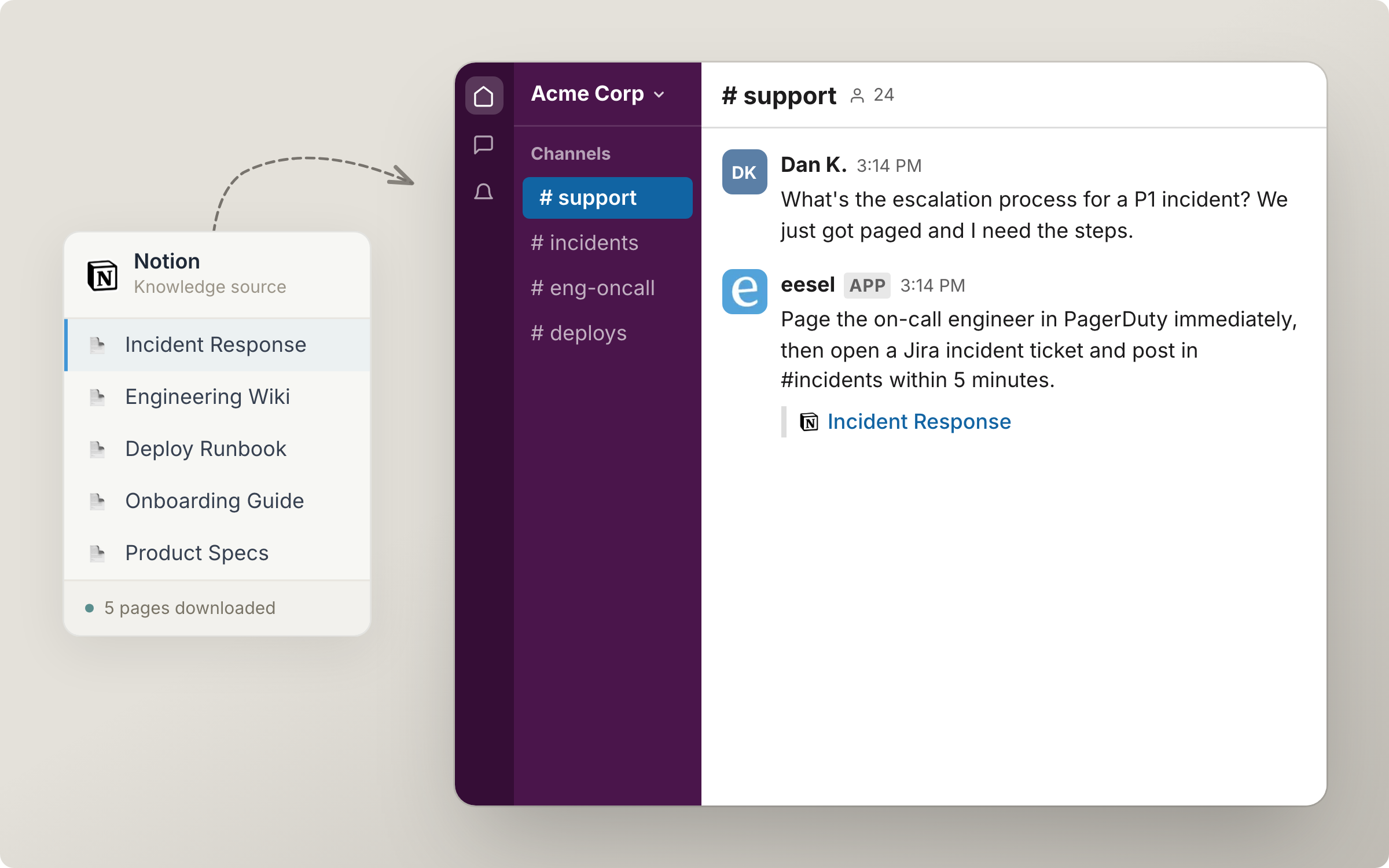
Connect Notion with one-click sign-in so your agent answers from the pages you share with it, including their properties and nested pages, and cites the page it used.
Invite your AI teammate into Notion and it answers from the pages you share with it, and cites the page it used. It reads the full text of each shared page, the properties on it, and any pages nested under it.
Nothing in Notion starts your agent. It answers when someone asks it. Notion has no triggers, and its one Write action stays off until you turn it on.

Quick start
Ask your agent to connect Notion
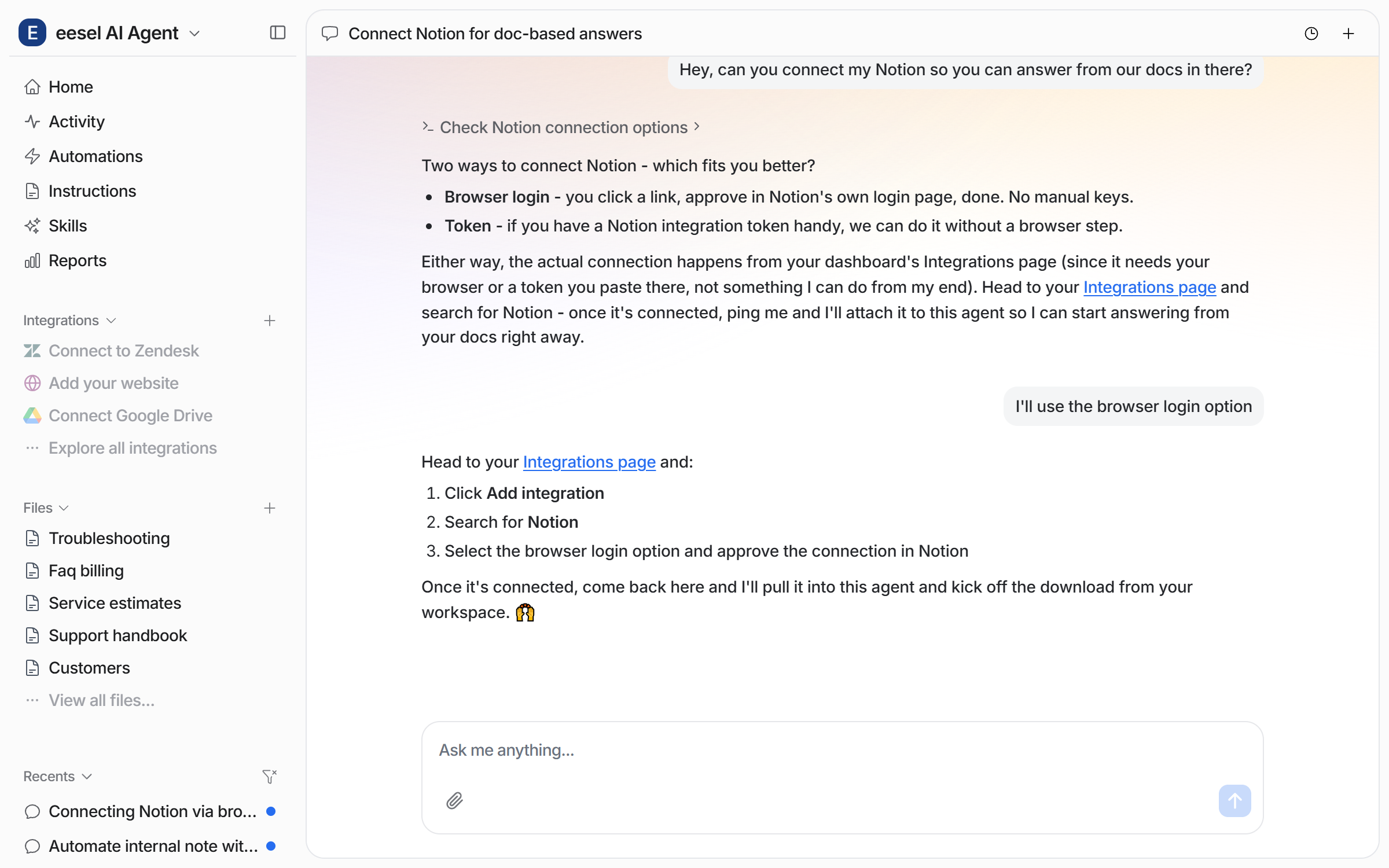
Open the chat in your dashboard and ask it to connect Notion. It offers two ways in: signing in with Notion in your browser, which most teams use, or a token. The connection happens on the Integrations page, because it needs your browser, and your agent links you there. On that page, click Add integration, search for Notion, and pick the browser sign-in option. You can also start from Integrations in the left sidebar.

Approve it in Notion and choose your pages
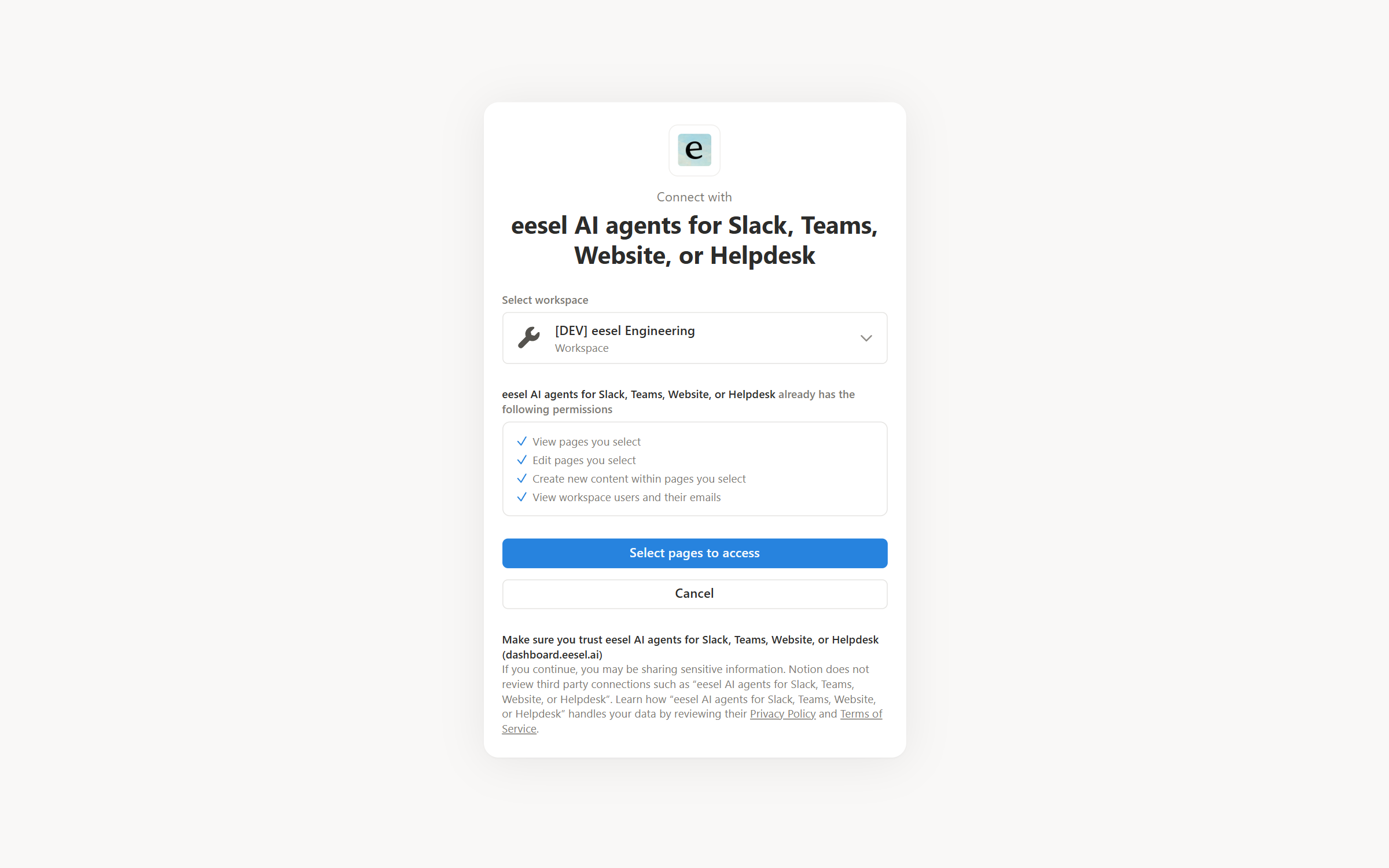
The link opens Notion's own screen. Pick the Notion workspace you want, read the permission list, and click Select pages to access. The permission list covers more than reading, because that is Notion's wording for this kind of connection. The one Write action that could change anything is off until you turn it on.

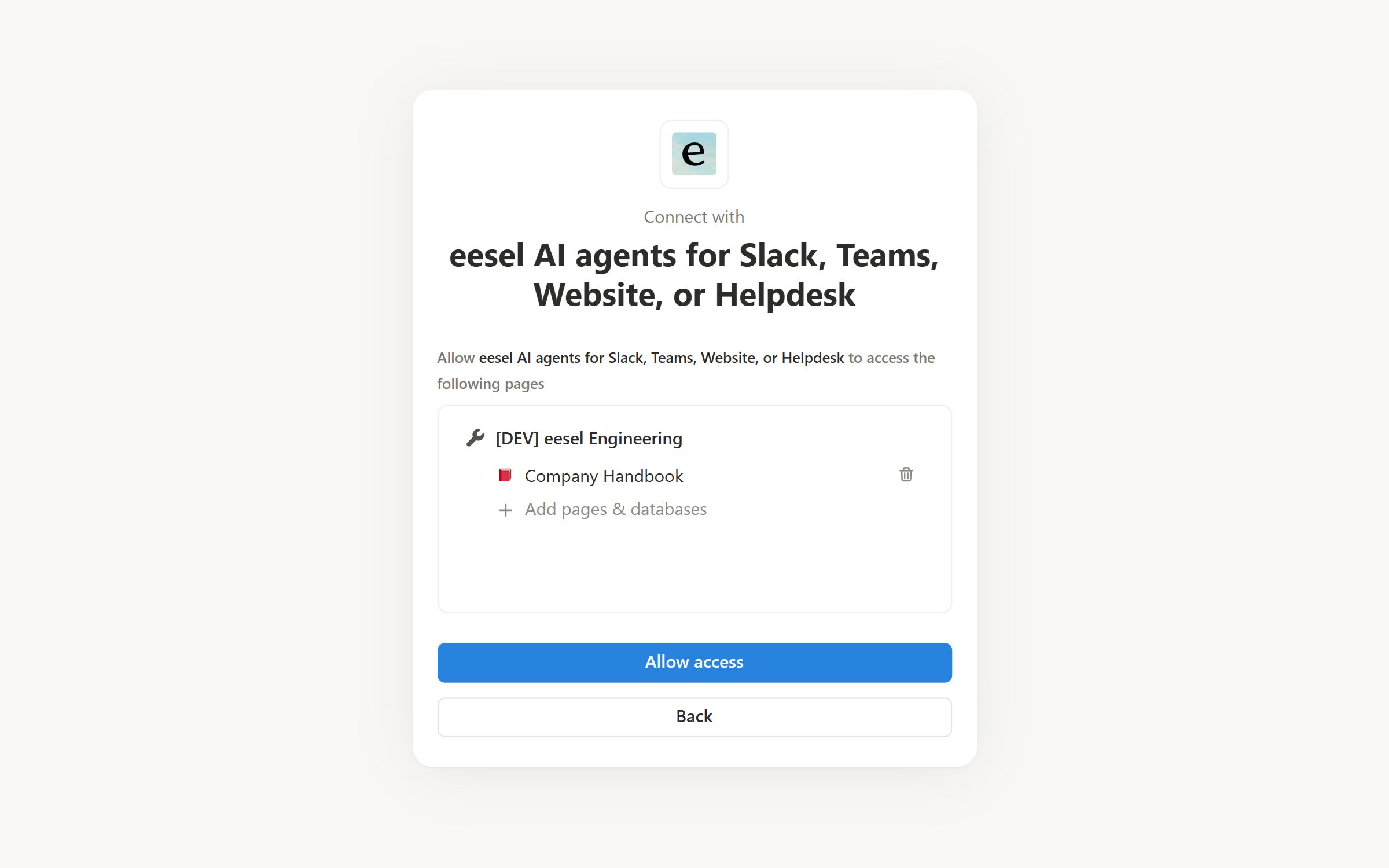
Next you choose the pages. Add each page you want answered from, then click Allow access. Only the pages listed here are shared. Pages nested under one of them come along with it, so a high-level parent page usually covers a whole area.

A person approves this in the browser.
Confirm the connection
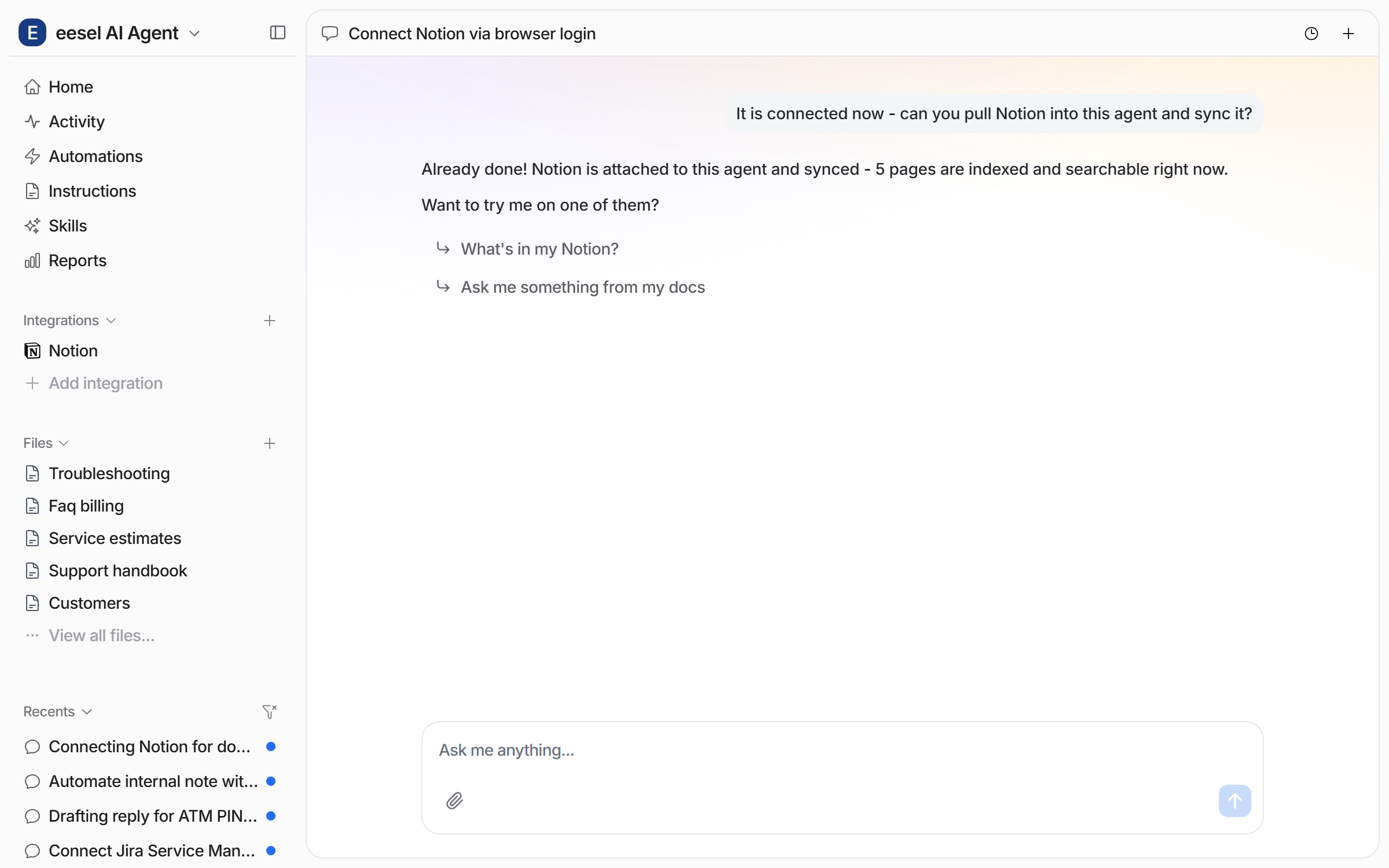
Go back to the chat and tell your agent the connection is done. It attaches Notion to this agent, starts the download of your pages, says how many pages are indexed, and suggests a first question.

Check it worked. The left sidebar now lists Notion under Integrations. From a terminal, eesel status shows the integration as connected with its source counts.
Check what it can read
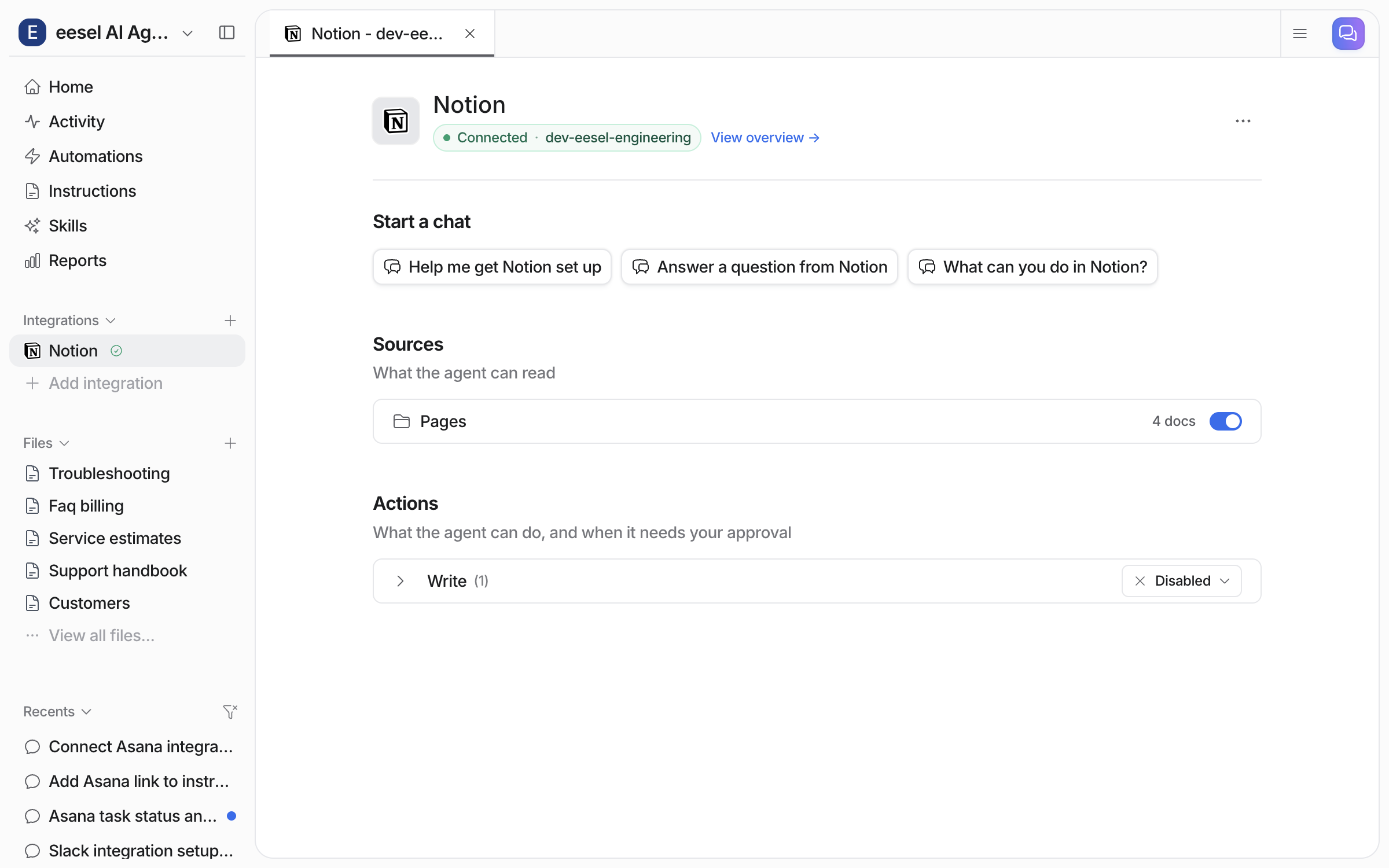
Integrations > Notion shows the connection as Connected, with the Notion workspace name. Sources lists what your agent can read, as a Pages row with its own document count and toggle. Actions lists what it can do, as a Write group set to Disabled.

Tell it how to answer
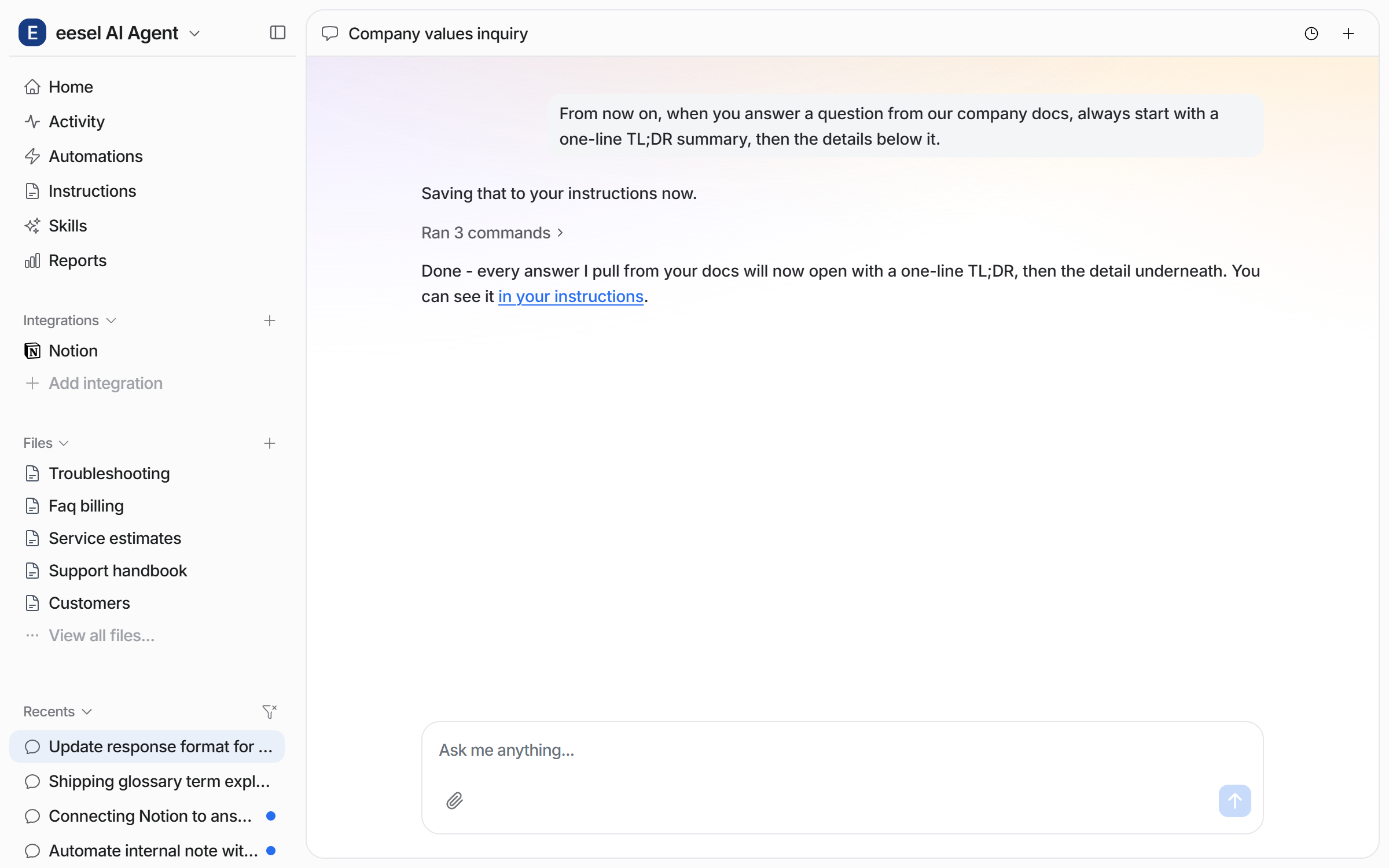
Tell your agent a standing rule in plain language and it saves the rule for next time. It says what it saved and links you to it.

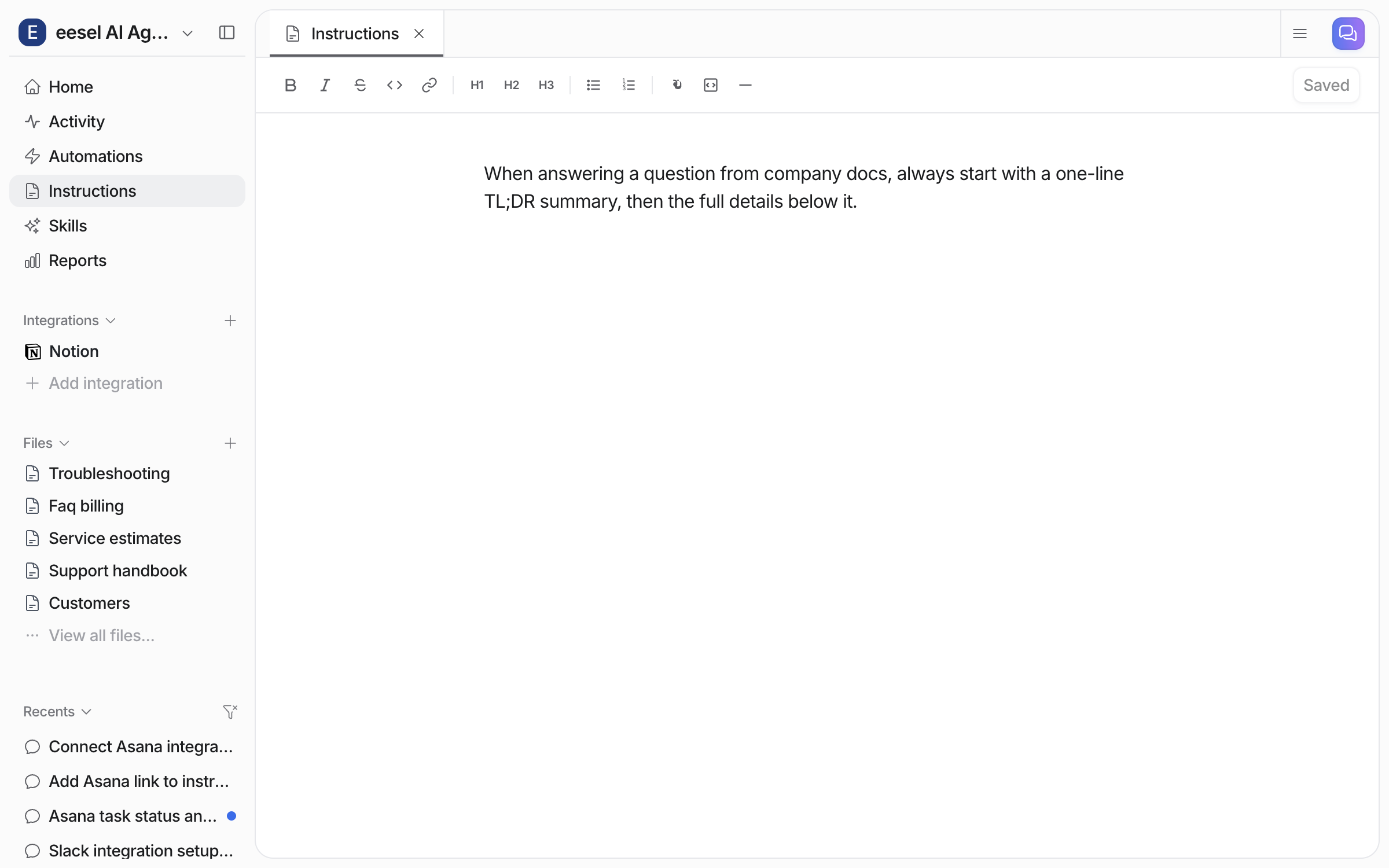
The saved rule lives on the Instructions page, where you can read it and edit it by hand.

Use it where your team works
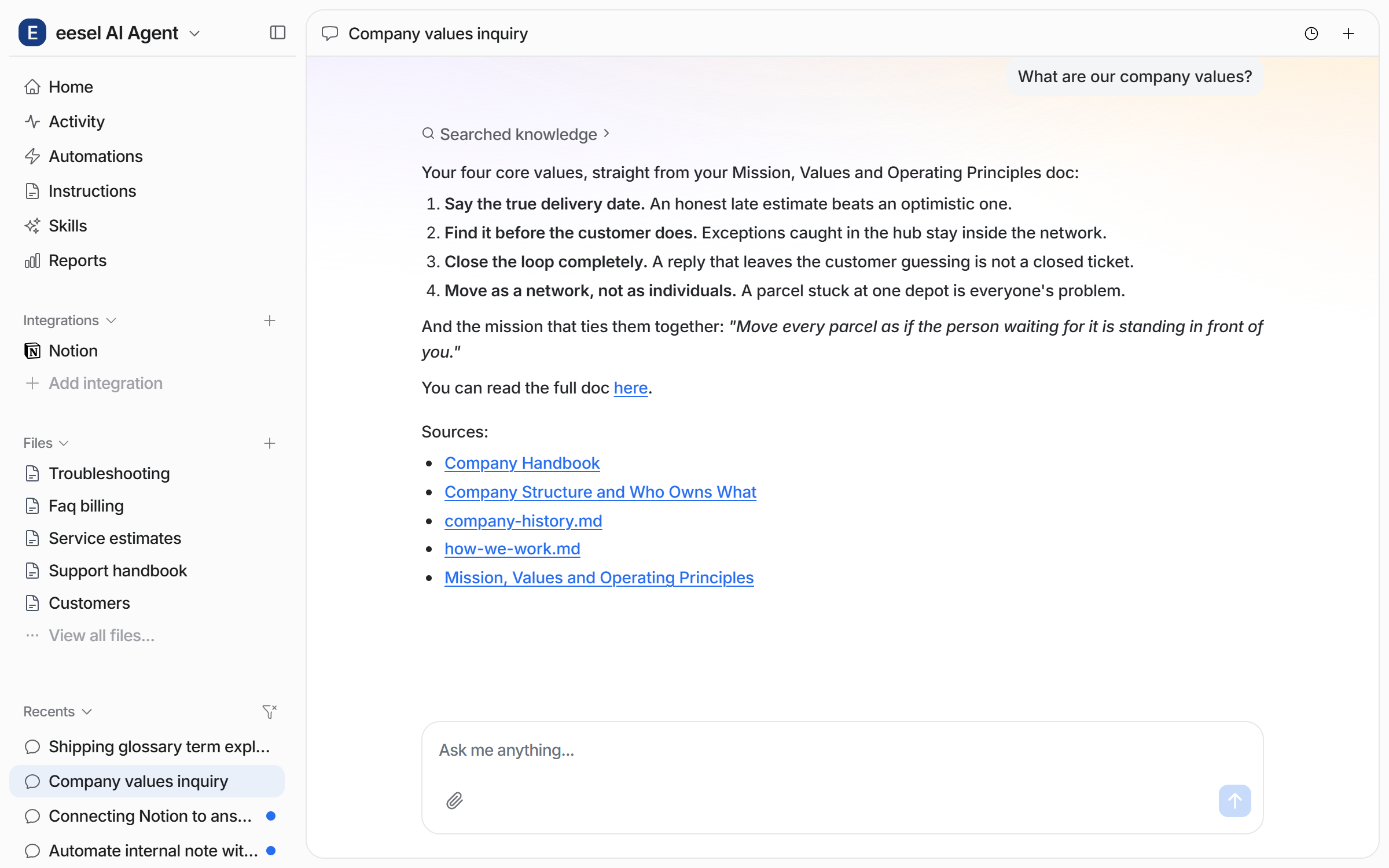
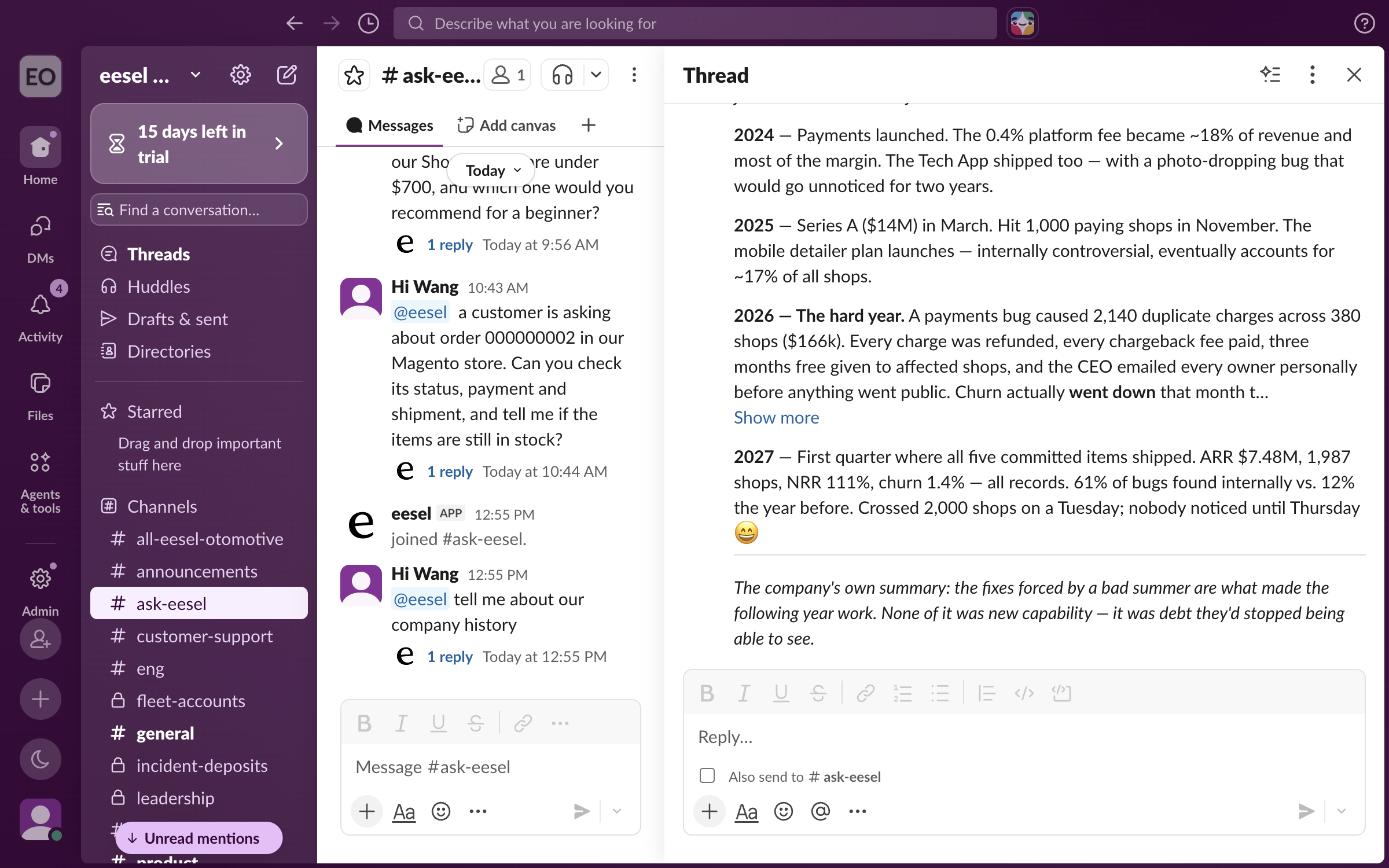
Your agent answers from the same Notion pages wherever it is working, and any rule you saved applies there too. A teammate can mention it in a Slack channel and get the answer in the thread. See Slack.

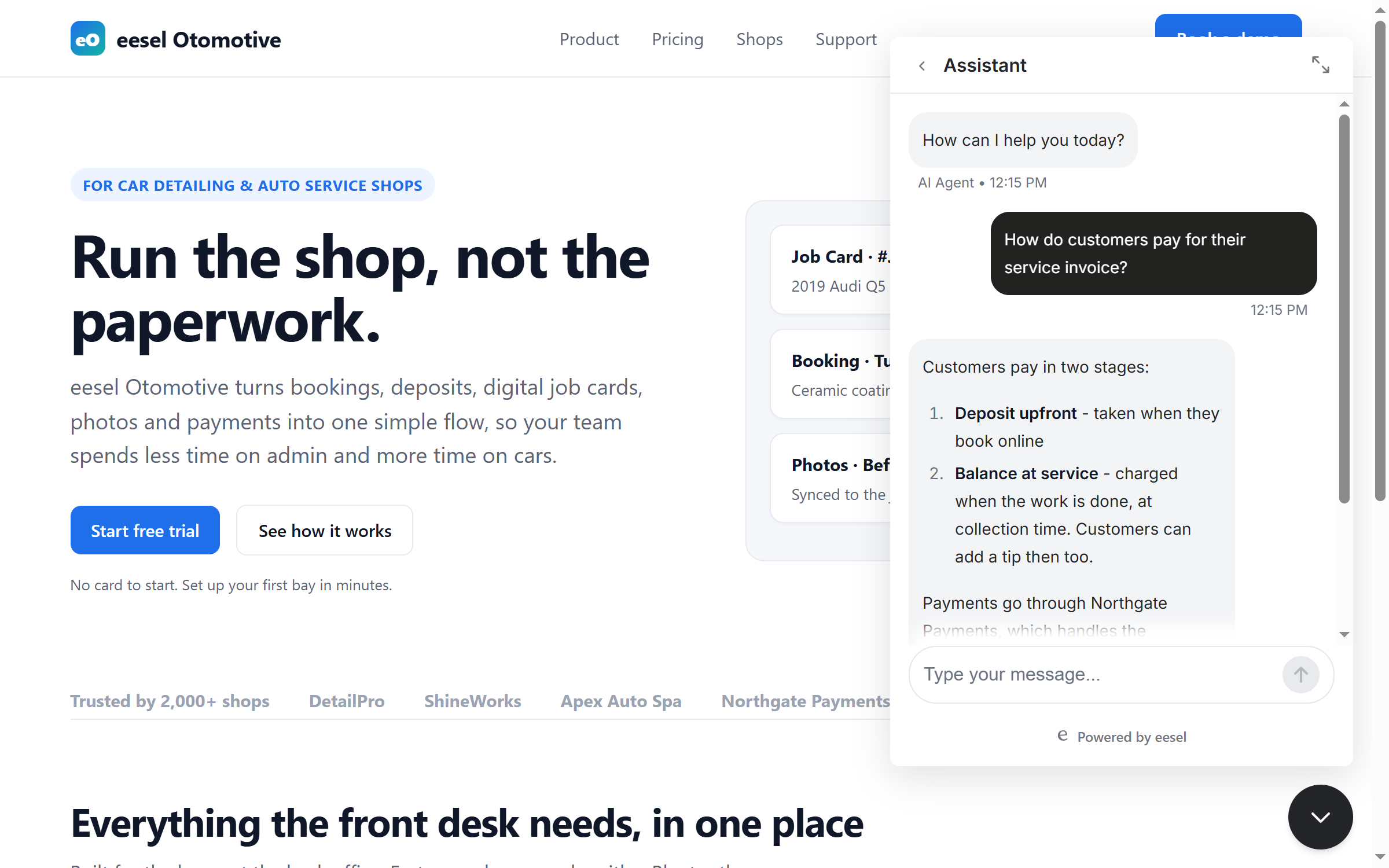
The chat bubble on your website draws on the same pages. See Chat bubble.

Sources and actions
Sources
Notion is a knowledge source. You pick the pages when you approve the connection, and you can take a page back out at any time. Everything your agent can read arrives on the integration page as the Pages row, with its own count and toggle. This is what that row holds.
Pages
The full text of every Notion page shared with the connection
The page listed when you approved the connection
Page properties
The properties set on each page, indexed alongside its text
As above
Nested sub-pages
Pages under a shared parent, picked up with the parent
A shared parent page
Databases are not synced. Your agent indexes Notion pages, not database objects. Content that only exists as rows in a database view is not indexed. Pages that live inside a database are still pages, so they sync normally once shared.
There is a cap of 15,000 pages per connection. Past that, the extra pages are left out rather than the sync failing. So narrow a very large Notion workspace to the pages you want answered from.
New pages do not arrive on their own. Your pages are indexed when you connect them. A page you create later under a shared parent is covered by that sharing, but it does not show up in your agent's answers straight away. If a new page matters and your agent does not seem to know about it, get in touch.
Every other integration on the agent is also a source. So a Notion answer can draw on Confluence, Google Drive, your helpdesk and your files at once. See Integrations.
Triggers
Notion has no triggers. Nothing that happens in Notion can start your agent. It answers from your Notion pages when someone asks it, in the dashboard, in Slack, and in the chat bubble.
Actions
Notion has one action, in a group called Write. Every action runs on its own, asks you first, or stays off. This one is off when you connect.
Write
Notion API request
Makes an authenticated request to your connected Notion workspace, so your agent can read or write a page, a database or a block
This is a general-purpose action rather than a named job like "create page", so decide carefully before you switch it on. Set it to ask you first and every use waits for a person, with Approve, Always allow and Deny in the dashboard. Left off, your agent can never change anything in your Notion workspace. See Actions and Approvals.
Troubleshooting
FAQ
Related pages
Last updated