> For the complete documentation index, see [llms.txt](https://docs.eesel.ai/llms.txt). Markdown versions of documentation pages are available by appending `.md` to page URLs; this page is available as [Markdown](https://docs.eesel.ai/use-cases/internal-operations.md).

# Internal Operations

Your AI teammate connects to every platform your team already works in. It holds context from all of them, takes action in them, and answers questions that span them, like a very fast colleague who has read everything: your docs, your tickets, your project tracker, your chat history.

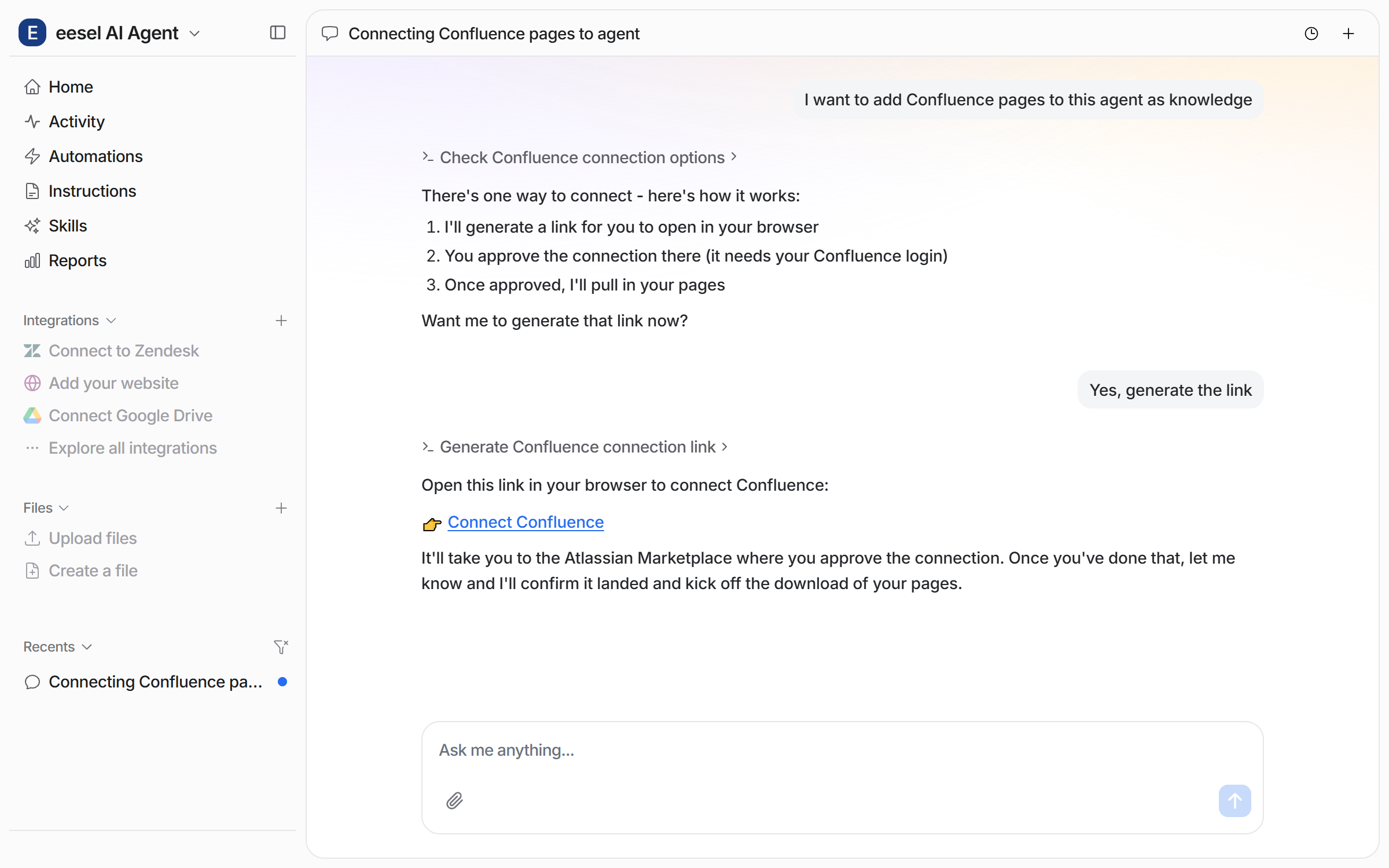
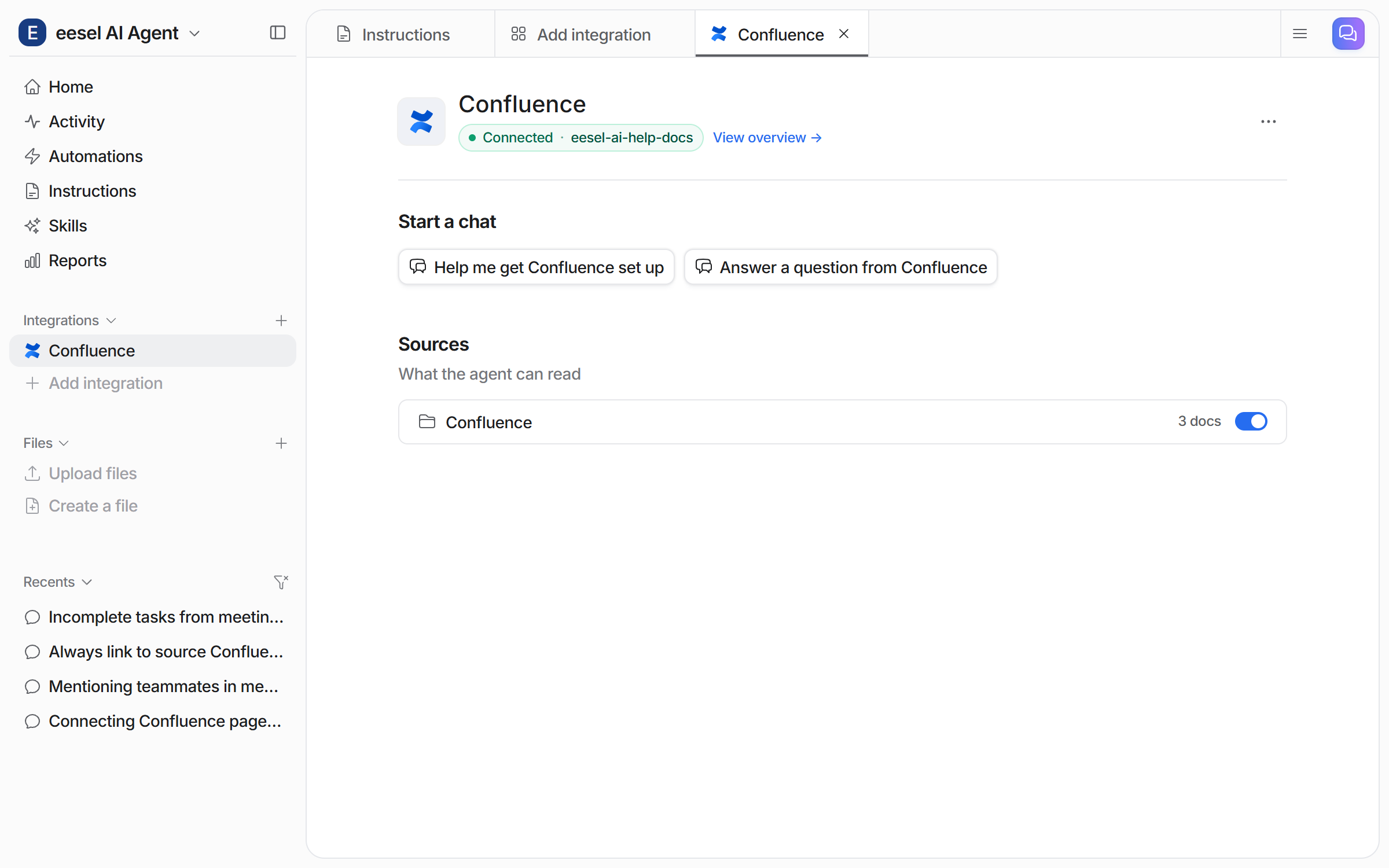
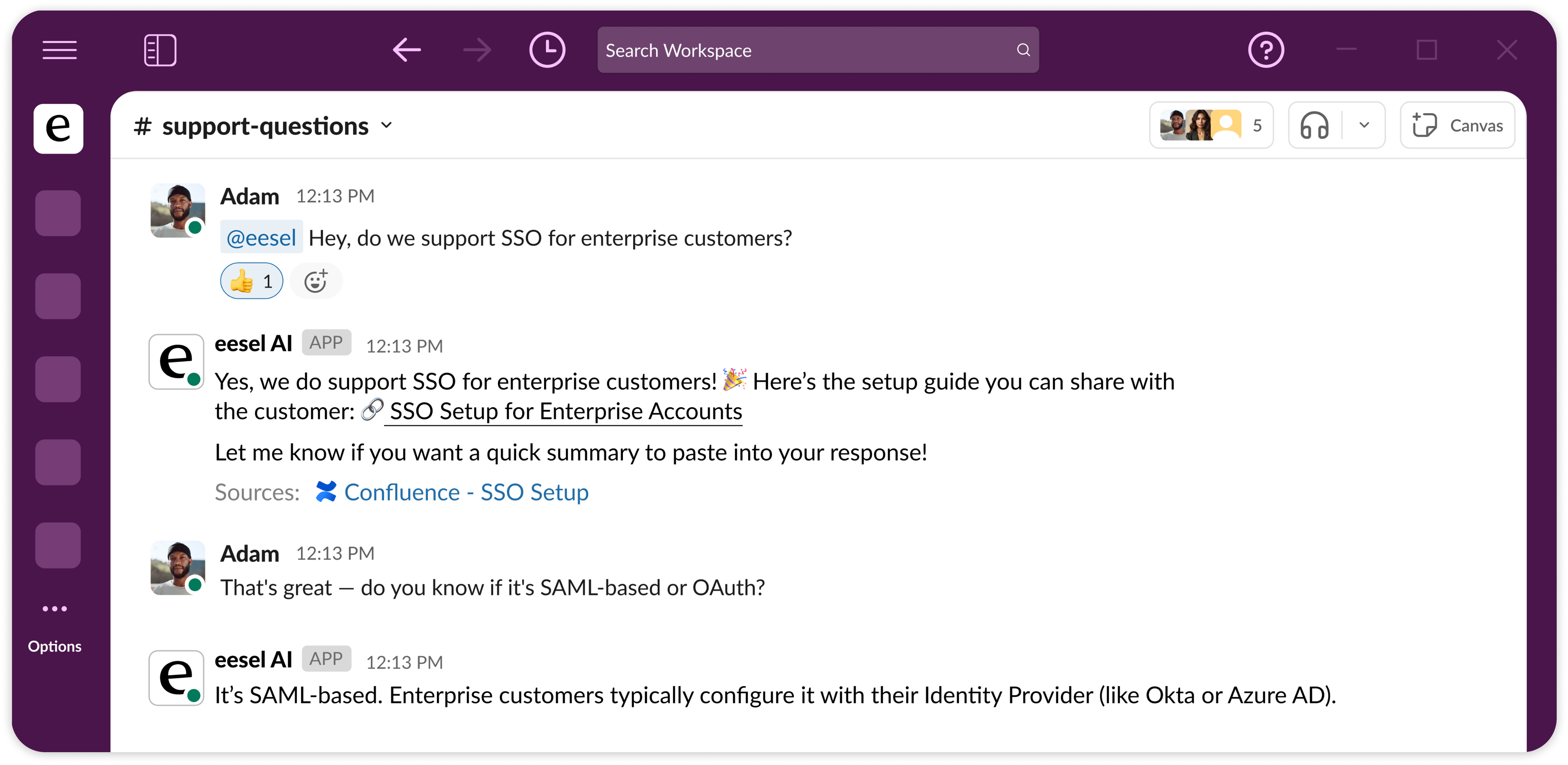
Instead of you searching through team chats and internal docs (Confluence, Notion, Google Drive, uploaded files), it does the searching and answers directly in the thread, with sources.

<figure><img src="/files/1otW2B2uer0kDB2FFdVw" alt="A team chat channel where someone asks whether the company supports SSO for enterprise customers, and eesel AI answers with a linked setup guide and cites the Confluence page it came from"><figcaption><p>Ask in the channel you're already in. The answer comes back in the thread, with the source it came from.</p></figcaption></figure>

**Ideal for:** hard-to-navigate knowledge bases, onboarding new hires, policy lookups, and the repetitive questions every team fields (IT, HR, ops).

## Quick start

{% stepper %}
{% step %}

### Create an agent

We recommend a separate agent for internal knowledge, so its instructions stay focused on your team rather than your customers. One agent *can* hold both roles if you prefer. Use the agent dropdown at the top left.

<img src="/files/FRR3n4H0Z07k7rBGLxgu" alt="The Create Agent dialog in the dashboard asking for the new agent&#x27;s name" width="563">
{% endstep %}

{% step %}

### Tell it about your business

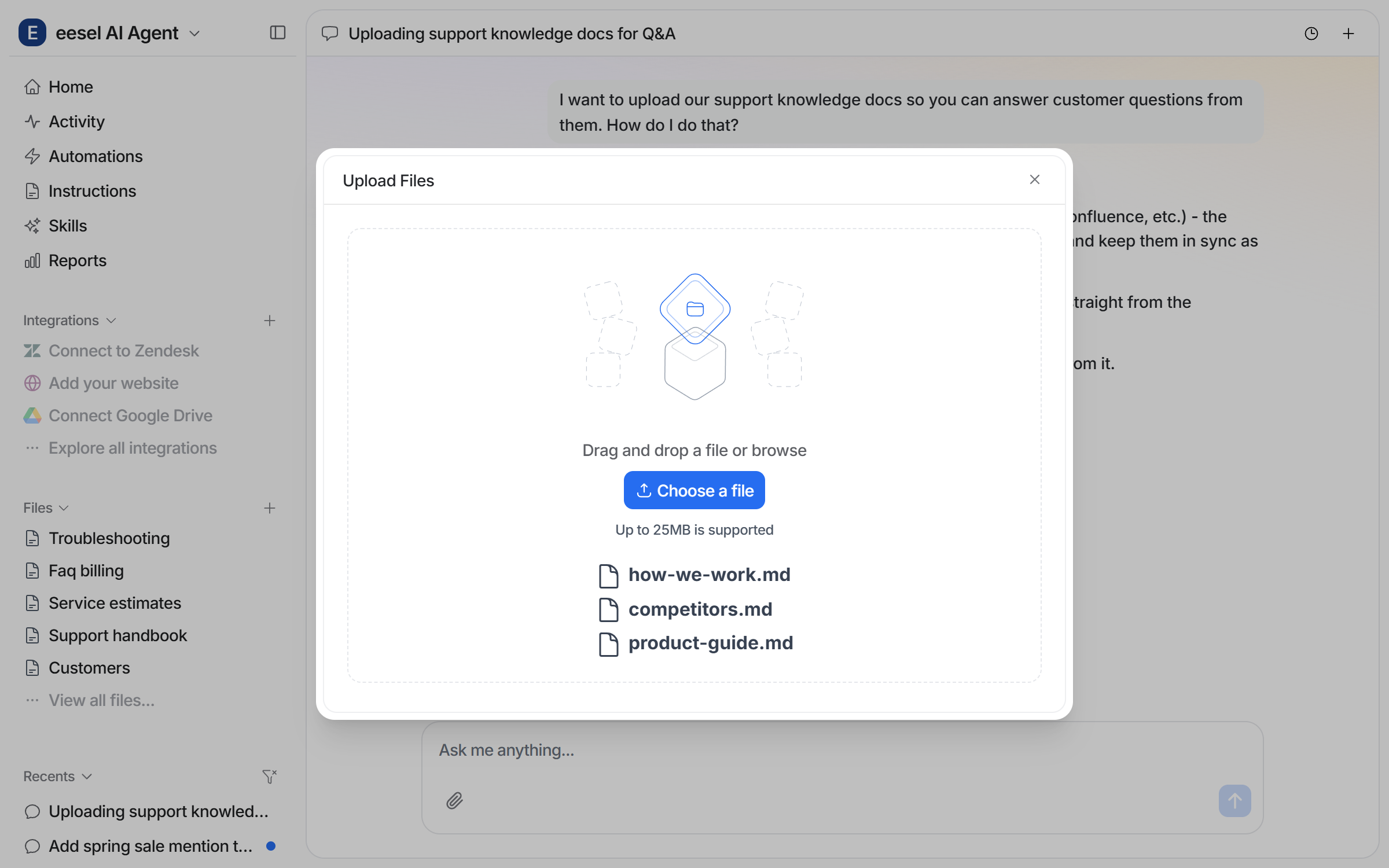
Open the chat and talk to it: what your company does, how your team is structured. Ask it to connect the places your knowledge lives and it walks you through each one. Or just upload the documents you'd hand a new starter.
{% endstep %}

{% step %}

### Connect it to your team chat

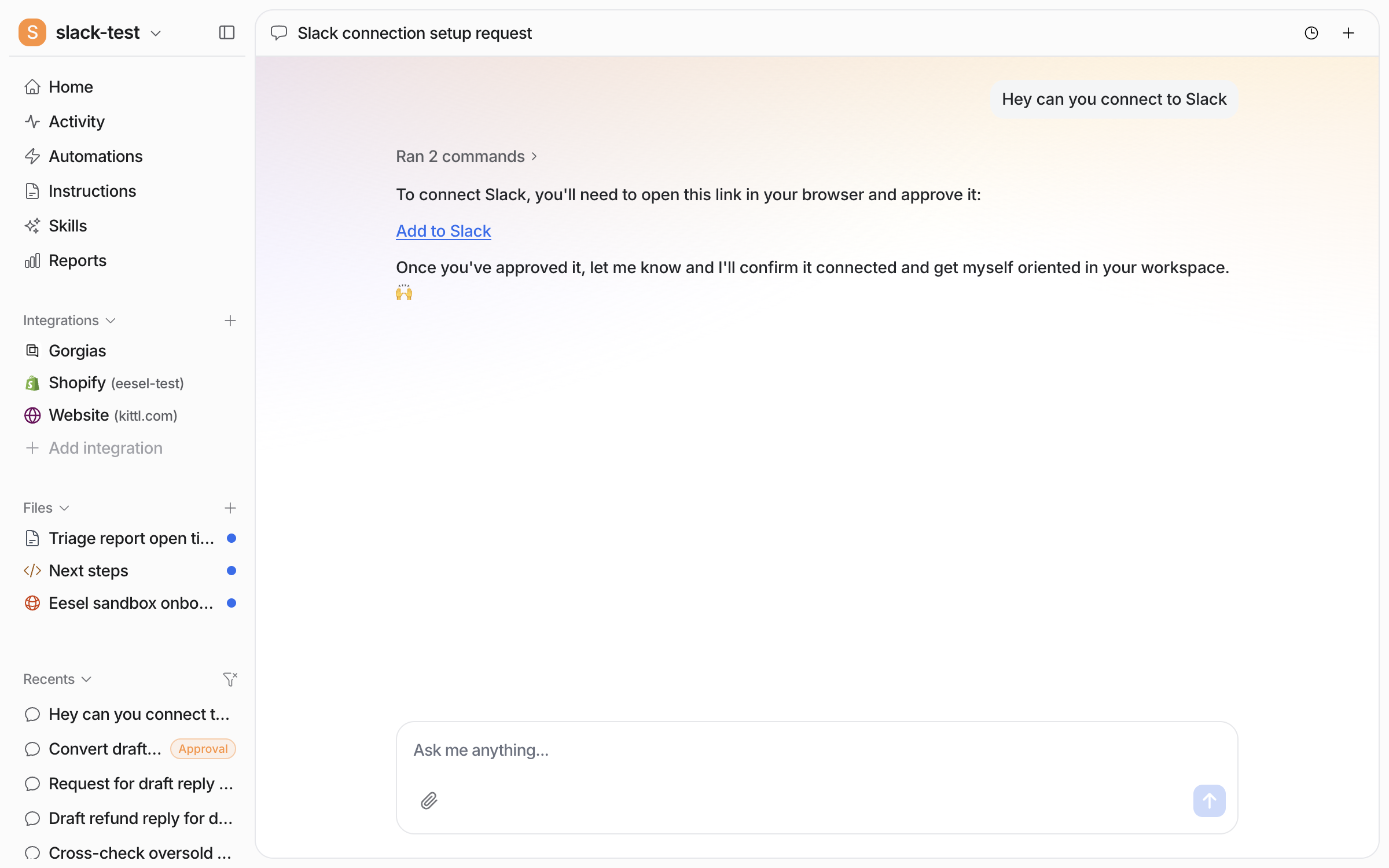
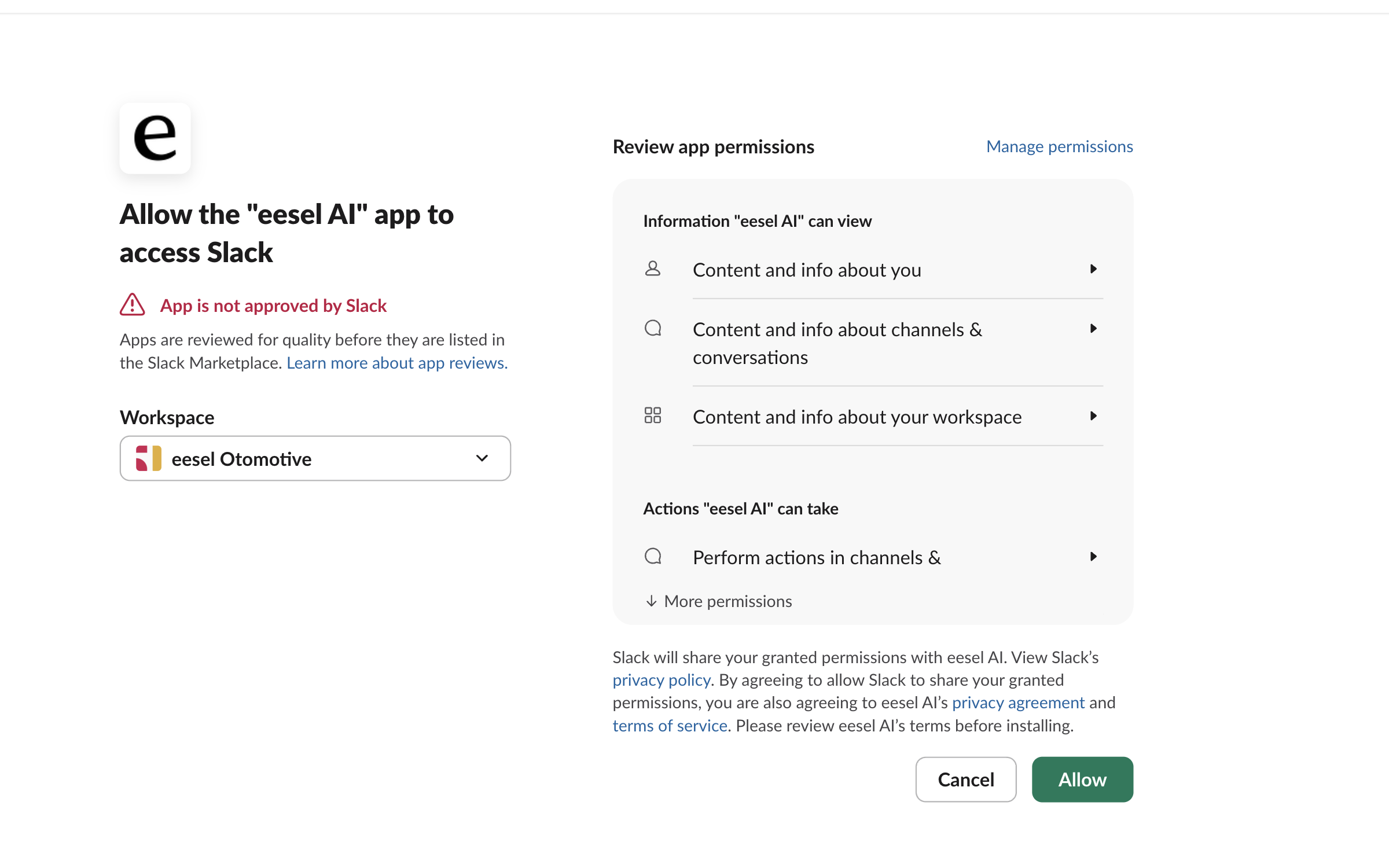
Ask your agent to connect the chat platform your team uses, then tell it which channels to be active in.

<img src="/files/JQ5MpIBRoOUediW4vKT3" alt="The eesel dashboard chat where the user types hey can you connect to slack and the agent generates the authorization link" width="563">
{% endstep %}

{% step %}

### Brief it on the job

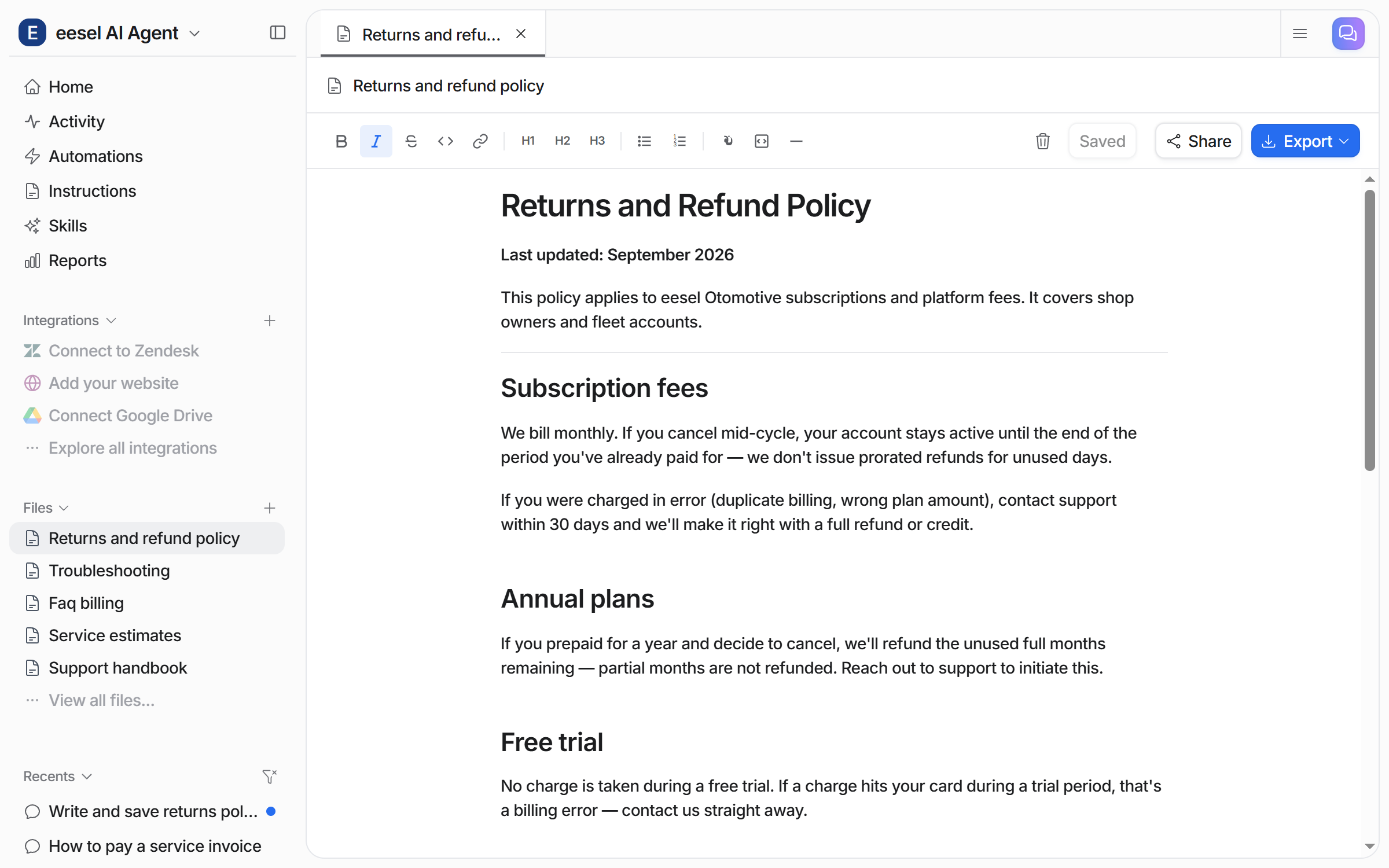
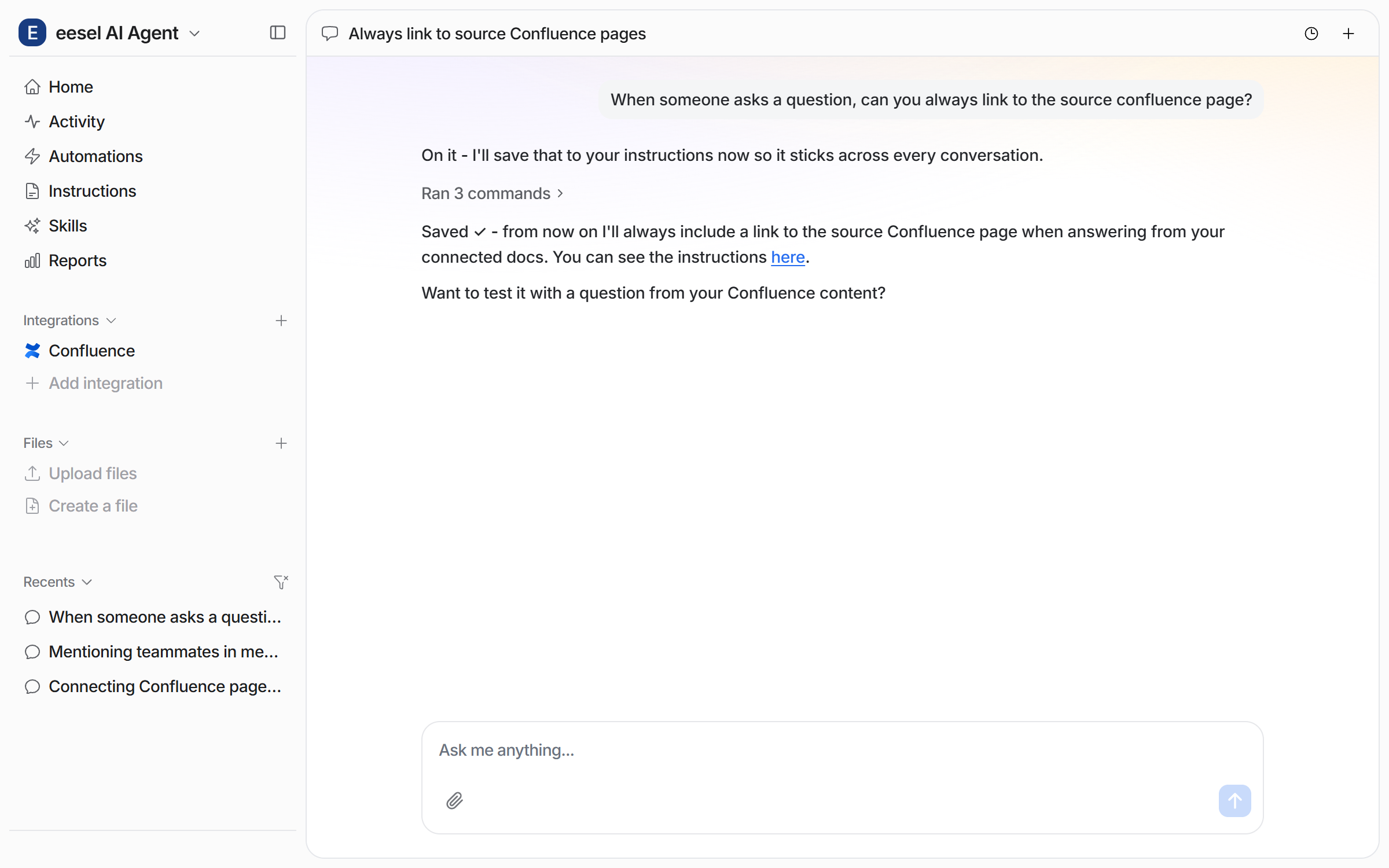
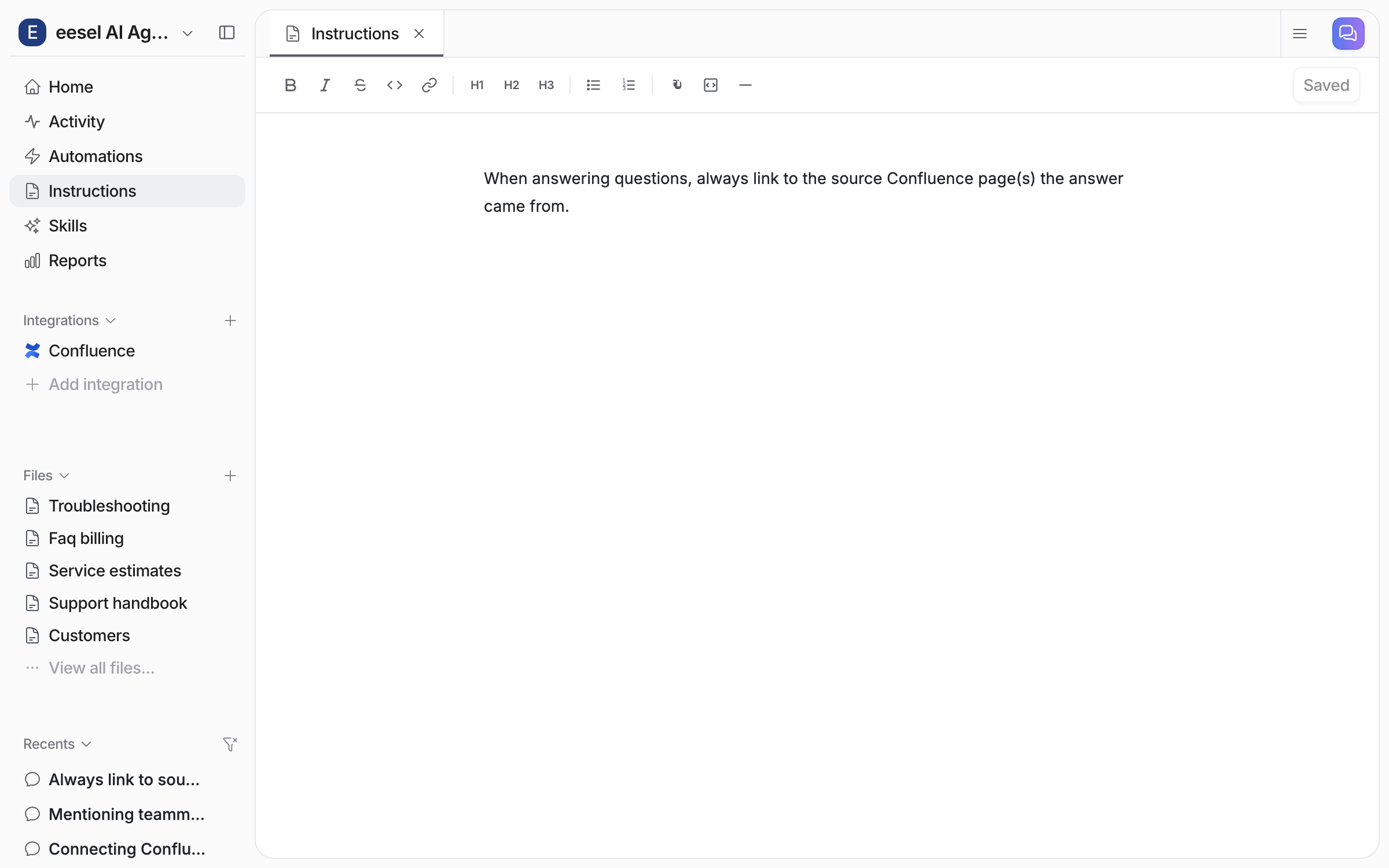
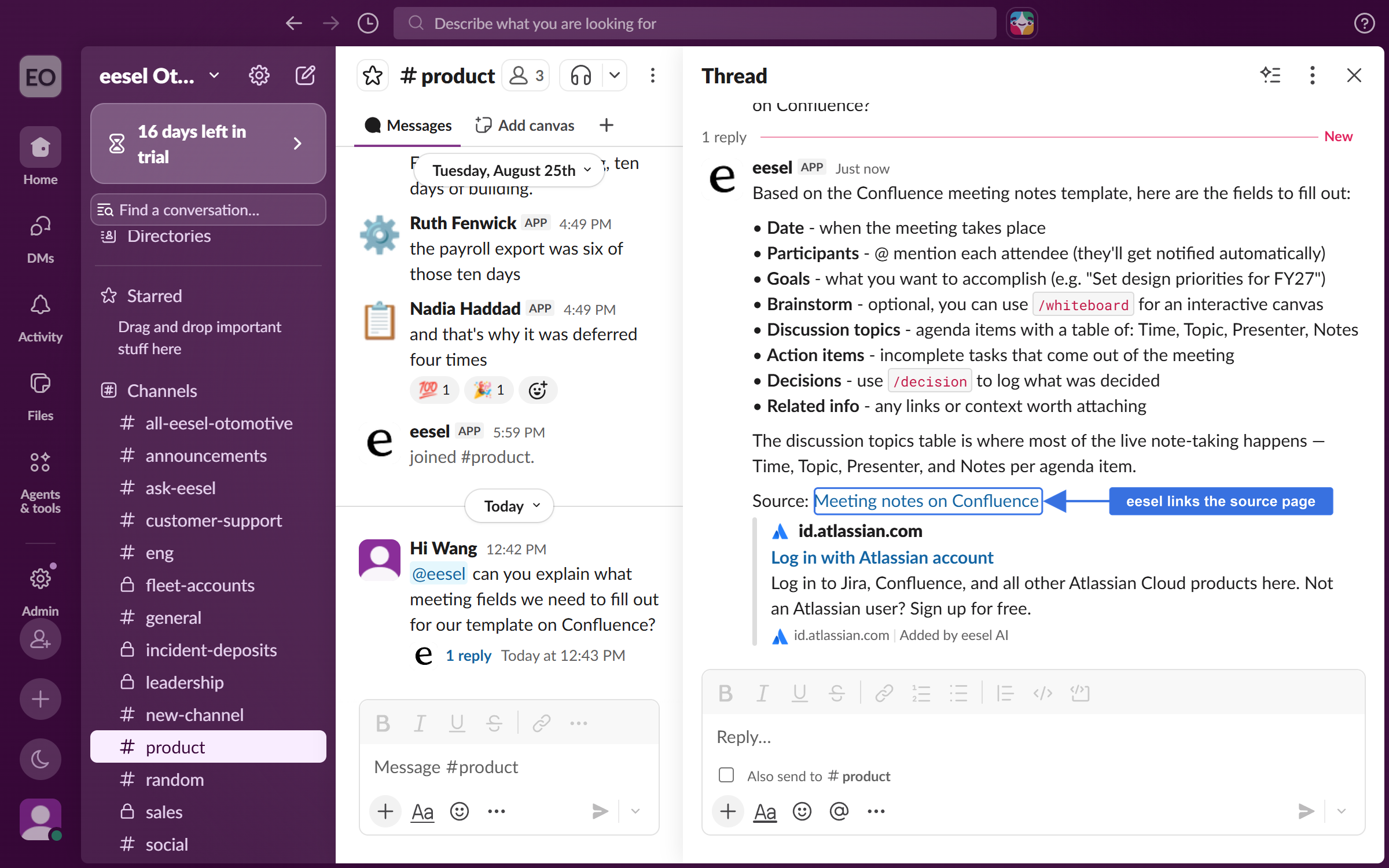
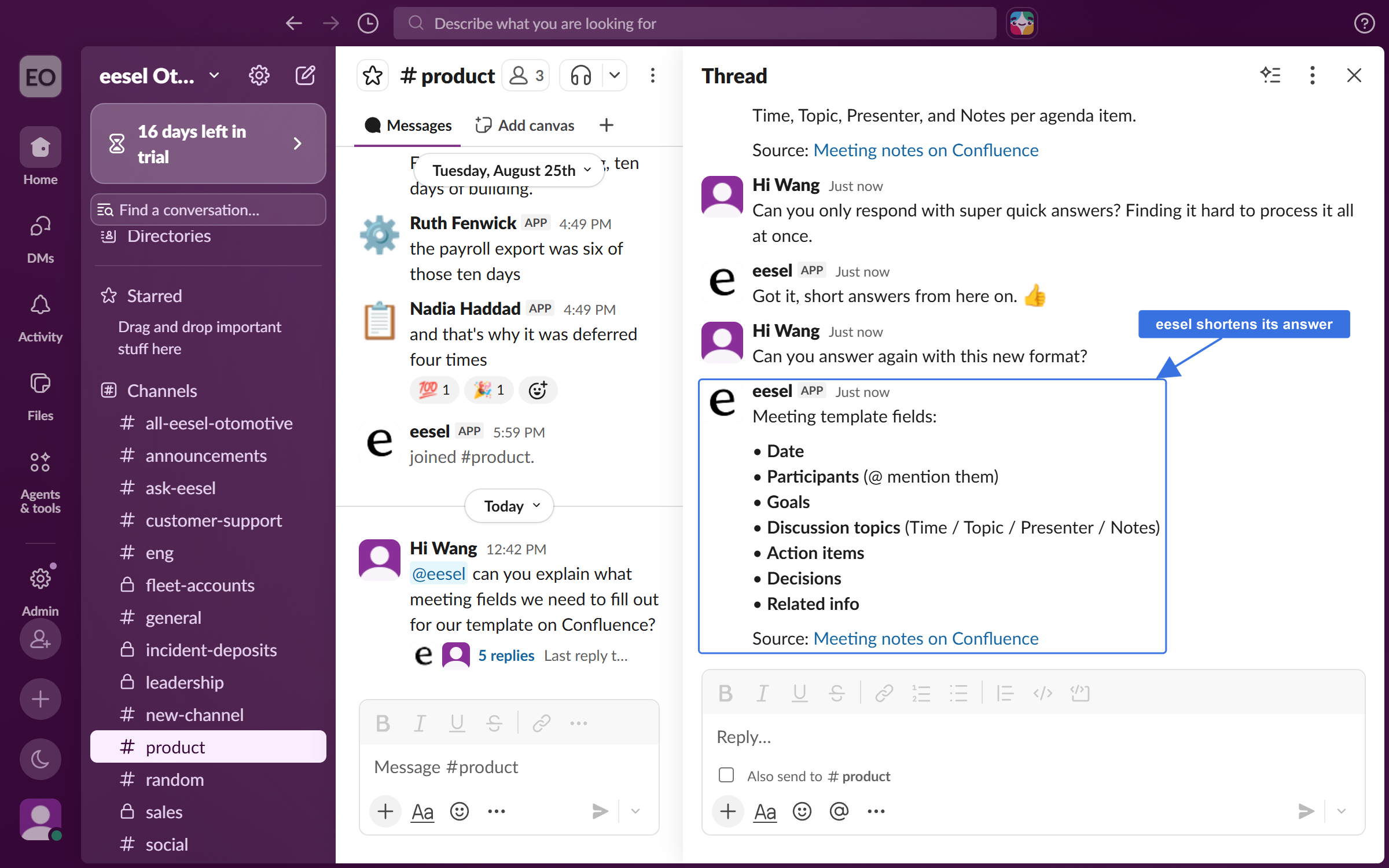
Tell it what tone to use, which sources to trust first, and when to escalate to a human. Then ask it something in a real channel and correct it as you go: it saves your corrections to its own instructions, so you only say things once.

<img src="/files/cADJC3MtkkaZ9dkPxGsV" alt="A Slack channel where a teammate @mentions eesel with a question and the agent answers in the thread" width="563">
{% endstep %}
{% endstepper %}

## What it can do

### Answer

It searches everything it's connected to at once, and every answer links back to its source. If it can't find something, it says so.

| It can                            | For example                                                |
| --------------------------------- | ---------------------------------------------------------- |
| **Answer from your knowledge**    | "What's our refund policy for orders under $50?"           |
| **Search across tools at once**   | Pulls from Confluence, Notion and Drive in a single answer |
| **Summarise a thread or channel** | "Catch me up on what I missed here"                        |
| **Find old decisions**            | "Did we ever decide how to handle this?"                   |

### Act

| It can                       | For example                                                  |
| ---------------------------- | ------------------------------------------------------------ |
| **Create and route tickets** | "Raise a ticket for this and assign it to billing"           |
| **Write content**            | "Write a blog post about this feature"                       |
| **Run skills and reports**   | "Run the ticket trends report and post it here"              |
| **Look up records**          | "What's the status of order 4821?"                           |
| **Combine systems**          | "Find this week's tickets about this bug and summarise them" |

One request can cross tools that don't talk to each other. That last example is a single ask, not a project.

### Notice

Put it on a [schedule](/automations-and-schedules/automations-and-schedules.md) or hook it to an event and it works without being asked:

| It can                       | For example                                           |
| ---------------------------- | ----------------------------------------------------- |
| **Watch your SLAs**          | Pings the channel before a ticket breaches, not after |
| **Flag spikes**              | Tells you when a topic starts trending in support     |
| **Post recurring summaries** | A digest every Monday, before your meeting            |
| **Chase what's slipping**    | Tells the person who owns it, not the whole channel   |

### Extend

[**Skills**](/skills/skills.md) are packaged workflows (a simulation, a trend report, a blog post) that run on demand, on a schedule, or off a trigger. Build your own by describing it in chat. [**Custom API access**](/apis-and-developer-resources/network-access.md) lets your agent reach internal tools eesel doesn't integrate with directly.

## Example use cases

* **New hire onboarding.** "What's our PTO policy?" / "How do I set up VPN?"
* **Sales enablement.** "What integrations do we support?" / "Do we have a SOC 2 cert?"
* **IT support.** "How do I reset my email password?"
* **SLA watch.** Pings the channel before a ticket breaches.
* **Project manager.** Pulls status from across your tools, summarises it against your goals, and pings owners of anything slipping, on a schedule, before your weekly meeting.
* **Scheduled reporting.** Collects the numbers, writes the summary, posts it every Monday.

## Related

* [Slack](/integrations/slack.md) for connecting Slack and what your agent can do there
* [Automations and Schedules](/automations-and-schedules/automations-and-schedules.md) for schedules and triggers
* [Skills](/skills/skills.md) for prebuilt and custom workflows
* [Network Access](/apis-and-developer-resources/network-access.md) for your own internal APIs


---

# Agent Instructions
This documentation is published with GitBook. GitBook is the documentation platform designed so that both humans and AI agents can read, navigate, and reason over technical content effectively. Learn more at gitbook.com.

## Querying This Documentation
If you need additional information that is not directly available in this page, you can query the documentation dynamically by asking a question.

Perform an HTTP GET request on the current page URL with the `ask` query parameter, and the optional `goal` query parameter:

```
GET https://docs.eesel.ai/use-cases/internal-operations.md?ask=<question>&goal=<endgoal>
```

`ask` is the immediate question: it should be specific, self-contained, and written in natural language.
`goal` is optional and describes the broader end goal you are ultimately trying to accomplish on behalf of the user. GitBook uses it to tailor the answer towards what is most useful for that goal.

The response will contain a direct answer to the question and relevant excerpts and sources from the documentation.

Use this mechanism when the answer is not explicitly present in the current page, you need clarification or additional context, or you want to retrieve related documentation sections.